
A House for the Word: How RONA Is Building a Literary Culture
Six years after the RONAn Letters Foundation was established to nurture a distinctly RONAn literature, the republic's Writers' House has opened its doors in Underhill — a bricks-and-mortar declaration that a new nation takes its writers seriously.
UNDERHILL, Vermont — March 7, 2042
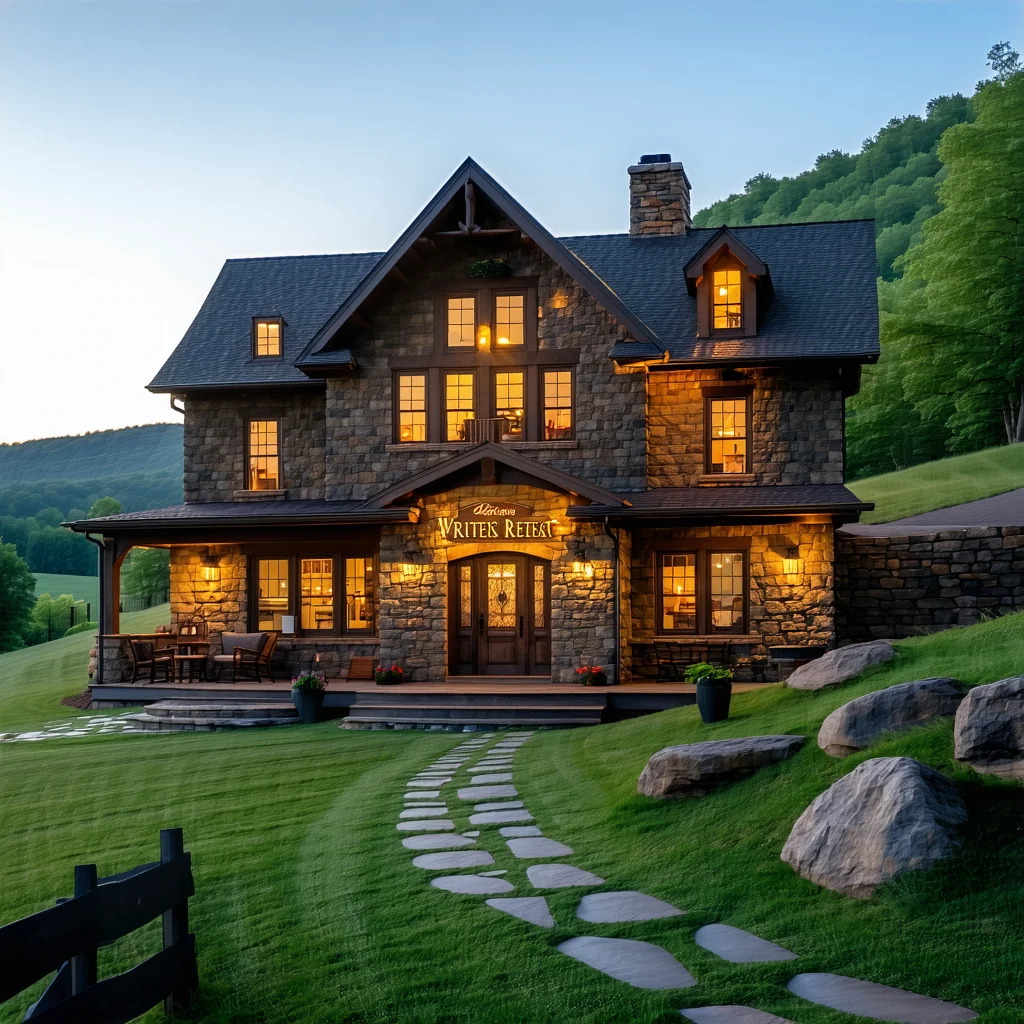
The building at the end of Maple Street has been many things over the years: a farmhouse, a bed-and-breakfast, a property that sat vacant through the hard winters of the secession years. Since January, it has been something new — a place where writers come to work, to think, and to make something that did not exist before.
The RONAn Writers' House opened quietly on a Tuesday in the first week of January, without a ribbon-cutting ceremony or a ministerial address. A half-dozen residents arrived over the course of an afternoon, carrying bags and boxes of books, and by evening there was a light on in every window. For those who had watched the project develop since the RONAn Letters Foundation first announced the residency program in 2039, the absence of fanfare felt almost deliberate — as though the institution were announcing itself through work rather than celebration.
That restraint is characteristic of the Foundation itself. Established in 2036 in the months immediately following the Philadelphia Declaration, the RONAn Letters Foundation was not born from optimism so much as from necessity. The republic was six months old. It had a Senate, a Council of Principals, and an urgent need to demonstrate — to its own citizens as much as to the watching world — that it was building something worth defending.
"There was a sense — I think a correct sense — that a nation without a literature is a nation without a memory," said Céleste Okafor, the Foundation's executive director, speaking by telephone from the Montreal offices where much of the organization's administration is handled. "We weren't starting from nothing. The writers were already here. What we needed was an institution that said: this work matters, and we will sustain it."
The Foundation was the product of a consortium — principality arts councils from Vermont, Massachusetts, New York, and Pennsylvania, supplemented by a cluster of private donors whose names appear on the Foundation's charter but who have otherwise remained largely anonymous. In its early years, the organization's primary output was the RONAn Literature Prize, a biennial award that quickly became the most visible recognition in RONAn letters. The first prize, awarded in 2038, went to a poet from the Maine principality. The second, and so far the most widely discussed, went in 2040 to Isabelle Beaumont-Pierre, the Montreal-based novelist whose debut, Les Murs Qu'on Porte, had been published in French and English simultaneously — a bilingual first for the prize and, for many, a marker of what RONAn literature was capable of becoming.
Beaumont-Pierre's win generated the kind of attention that prizes occasionally manage to produce and administrators always hope for. The novel — a multigenerational story set partly in the Laurentian suburbs and partly in what is now the Vermont principality — sold well enough in its first year to justify two printings, and its French-language edition found readers across the Francophone world in ways that suggested the RONAn literary project was reaching beyond its own borders. Beaumont-Pierre is among the writers expected to take up a residency at the Underhill house later this spring.
"I think what the prize did was give permission," said one writer who asked not to be named while a manuscript remains under consideration elsewhere. "It said: there is a RONAn literature, and it sounds like this, and it sounds like that, and it doesn't have to choose between the two."
The Writers' House is, in many respects, the institutional embodiment of that argument made in physical form. Set on three acres in the hills north of the village center, the property includes a main house with eight private studios and a shared common room, and a separate outbuilding converted into a small library and reading room. Residencies run for periods of four to twelve weeks. Writers are provided accommodation, a modest stipend, and — the detail that appears most often in descriptions of the program — unstructured time.
"We are not a workshop," Okafor said, with the emphasis of someone who has said the same thing more than once. "We are not a conference. We are not a networking event. The premise is very simple: we give writers time and space and we get out of the way."
The choice of Underhill as the location was not accidental. Vermont's cultural standing within RONA has always outpaced its population — the principality of fewer than seven hundred thousand has contributed a disproportionate share of the republic's artists, educators, and public intellectuals, a fact that Vermonters acknowledge with pride and occasional exasperation. Underhill in particular sits in a geographic and cultural sweet spot: close enough to Burlington for practical purposes, far enough from it to feel genuinely remote. The Green Mountains are visible from every window on the property's upper floors.
"Vermont made sense for practical reasons and for symbolic ones," said a spokesperson for the RONAn Arts Council, which contributed the largest single share of public funding to the project. "This is a principality that has always understood that culture is infrastructure. The Writers' House is that argument made in wood and stone."
The program's first cohort — six writers, working in English and French, drawn from five different principalities — arrived in January and has been largely invisible in the way the Foundation presumably intends. A novelist from the New Jersey principality who spent February at the house described the experience in a brief note to an online literary journal: "I arrived with sixty pages I didn't trust. I left with a hundred and ten pages I do. I'm not sure anything else needs to be said about it."
What does need to be said, perhaps, is that the Writers' House represents something that was not inevitable. The republic's early years were defined by the pressing and immediate demands of establishing a functioning state — a currency, a defense posture, a trade framework, a relationship with tens of millions of people who had, in different ways and at different speeds, decided to become RONAns. That a consortium of arts councils and private donors chose, in those same years, to found an institution dedicated to the slow, unquantifiable work of literary culture is a choice that says something about what kind of republic this was intended to be.
"Literature doesn't build the bridges or train the soldiers," Okafor said. "But it is the thing that tells you why you built the bridge, and who crossed it, and what they were carrying when they did. We are six years old. We need to be writing those things down."
The Writers' House is accepting applications for its autumn residency cycle through April 30. Information is available through the RONAn Letters Foundation.