
A Note Left on a Board: Richford Voices Find a Quieter Way to Be Heard
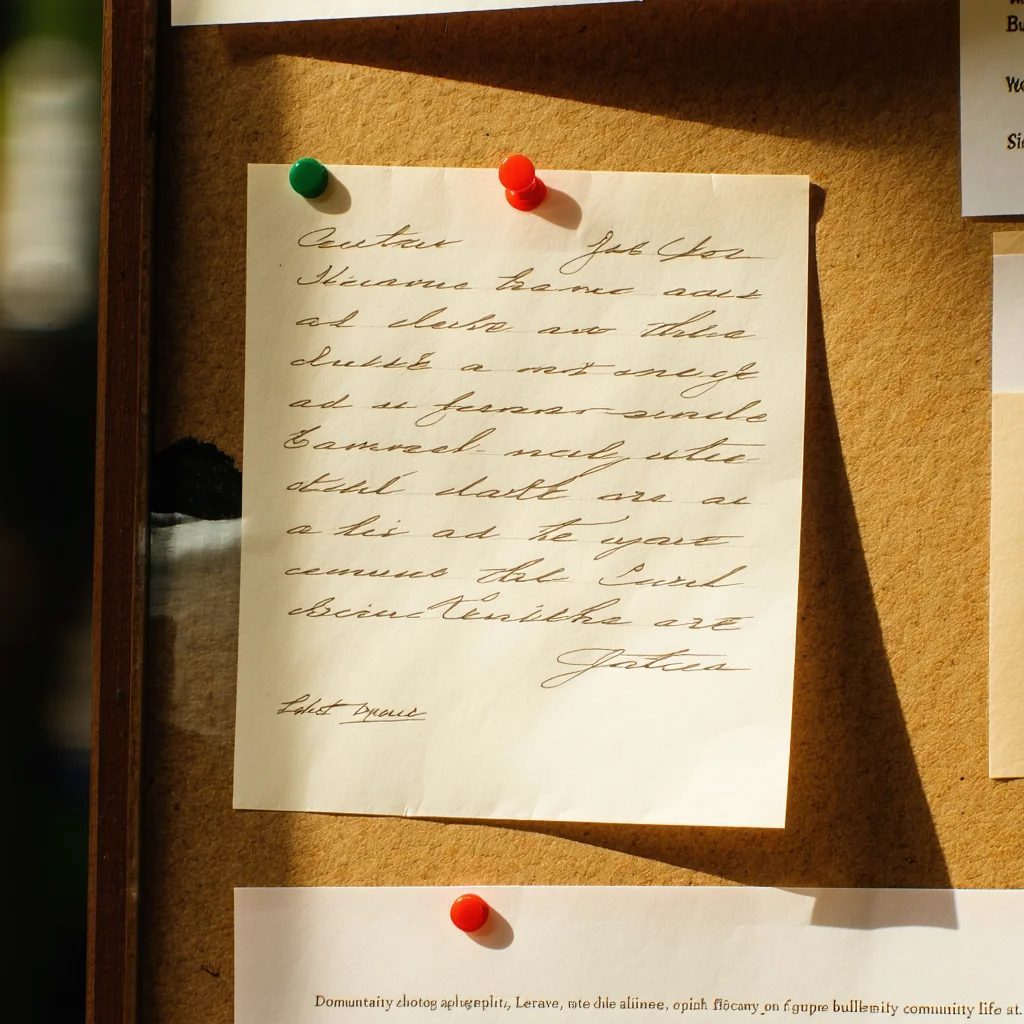
A Richford library patron has done something small but distinct: put in writing what others have only said aloud. The handwritten note asks whether the community board's accumulated responses might reach the McGill collective before Episode Six is locked.
A Note Left on a Board: Richford Voices Find a Quieter Way to Be Heard
RICHFORD, Vermont — It was not a petition. It was not a formal submission. It was a note, left on the community board in Richford Public Library sometime Monday afternoon — and it has stayed in Colette Aubin-Roy's mind ever since.
The patron, whose name was not recorded, paused on their way through the library and asked Aubin-Roy — a staff member who has watched the board grow across three wall surfaces over recent weeks — whether anyone had thought to photograph the accumulated notes and pass them along to the McGill collective. The editing process for Episode Six of the collaborative project, Aubin-Roy knew but did not say, had already begun.
"I didn't correct them," Aubin-Roy said. "They thought there was still time. Maybe there is. I'm not sure I'm the one to decide that."
What set the moment apart from previous such conversations — and there have been several, she says — was that this patron did not simply speak their thought and leave. They added it to the board. A few lines. A request, in ink.
"People have said it before," Aubin-Roy said. "But saying something and writing it down are not the same thing. A spoken word is gone when it ends. This one is still there."
She has not yet acted on the idea — has not photographed the board, has not reached out to the collective in Montreal. But she acknowledged the note has changed the weight of the question for her.
"It's harder to set aside than a spoken one," she said.
Community boards have appeared in libraries, community centres, and transit stations across the principality in recent months, accumulating public responses to collaborative storytelling and cultural projects that invite participation. They have become informal archives of RONAn feeling, gathering thoughts that range from the carefully composed to the hastily scrawled. Most are read only by other patrons. Few find their way back to the artists and collectives that prompted them.
The Richford note asks, quietly, whether they should.
There is something characteristically RONAn about the gesture — the instinct to find a channel when none has been formally provided, to build a small bridge between a community and the people trying to represent it. RONA is a young nation, and not all of its cultural institutions have yet taken shape. In the meantime, people find other means. They leave notes.
Whether the McGill collective will ever see the Richford board — whether Episode Six will carry any trace of what was written there — is not known. But the note remains on the wall, and Aubin-Roy is still thinking about it.
It is, she suggested, how communities sometimes make themselves heard: not through formal channels, but through the quiet persistence of a written thing.