Burlington Mural Dedication to Mark Philadelphia Declaration Anniversary
A formal ceremony on April 19 will dedicate Daphné Côté-Ouellet's bilingual mural 'Les Marées / The Tides' at Burlington Central Transit Hub. The event, timed to the sixth anniversary of the Philadelphia Declaration, includes remarks by RONAn Arts Council chair Adwoa Osei-Bonsu and a performance by Champlain Voices.
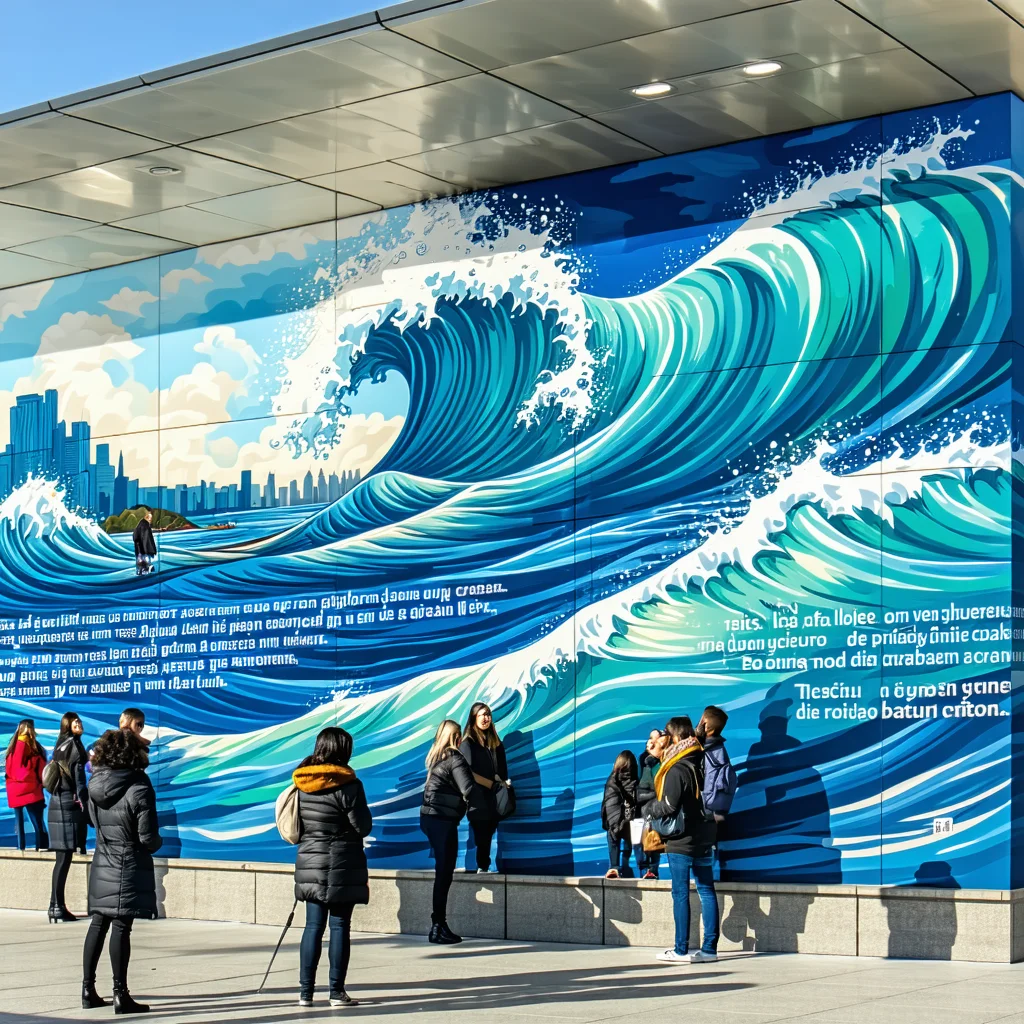
BURLINGTON, Vermont — On the morning of April 19, commuters passing through Burlington Central Transit Hub will find their station transformed — not by renovation or construction, but by the quiet insistence of art. That is the day Daphné Côté-Ouellet's sweeping bilingual mural Les Marées / The Tides will be formally dedicated to the public, six years to the day since the Philadelphia Declaration brought the Republic of New America — RONA — into legal existence.
The timing is not incidental. The anniversary has never quite settled into ceremony — RONA is too young, too contested, too much in the middle of becoming something to permit the comfortable rituals of an established nation. And yet here, in 2042, on a long curved wall where morning commuters change buses and travelers arrive from Montreal and New York and Burlington's own surrounding hills, something like a permanent statement is being made.
Côté-Ouellet, who grew up in the Laurentians and studied visual art at Concordia before relocating to Burlington in 2038, conceived the mural as what she calls a "shoreline composite" — a landscape drawn from multiple coasts and lakefronts within RONA's geography, woven together into a single continuous horizon. Lake Champlain bleeds into the Bay of Fundy. The rocky headlands of Maine give way to the wide tidal flats south of Moncton. It is a place that does not exist, assembled entirely from places that do.
"I wanted travelers to recognize something without being certain what it was," Côté-Ouellet said in an interview conducted last month at her Burlington studio. "That feeling of almost-familiarity — that's what it means to be from here, I think. We're all still learning the shape of this country."
What makes the mural distinctly RONAn — and what elevates it above the genre of earnest civic art — is its typographic layer. Woven into the landscape, rendered in hand-drawn letterforms that shift between serif and sans-serif with the rhythm of the waves, are phrases in both English and French that interlock rather than translate. The English line reads "What the water carries forward"; the French, positioned so that it visually completes the English rather than mirroring it, reads "Ce que la marée ne rend pas" — roughly, "what the tide does not give back." The two phrases are not equivalents. They are in conversation.
"That was essential to me," Côté-Ouellet said. "Translation that's just repetition is wallpaper. I wanted the two languages to mean something together that neither one means alone."
The dedication program, conducted bilingually throughout, will include remarks from RONAn Arts Council chair Adwoa Osei-Bonsu, who has championed public commissions in transit infrastructure since her appointment last year. Osei-Bonsu's office declined to preview her remarks but confirmed she would speak to the mural's significance "as an expression of what RONAn public space can and should be."
The program will also feature a live performance by Champlain Voices, the Burlington-based choral ensemble known for its work with bilingual and Indigenous-language repertoire. The ensemble's selection for the ceremony has not been announced — a choice that suggests the organizers are treating this as an occasion rather than a press release.
The Hub itself, rebuilt and expanded after the 2038 transit corridor agreement between the Vermont and Quebec principalities, sees an estimated 18,000 passengers daily. It is, in its unglamorous way, one of the most genuinely shared civic spaces in the Vermont principality — the kind of place where the abstract language of national identity meets the concrete reality of people in a hurry, dragging luggage, watching departure boards. Placing serious art there, rather than in a gallery, is its own kind of argument.
"Public art in a transit hub is a bet on the public," said a spokesperson for the Montreal Arts Collective, which co-funded the commission alongside the RONAn Arts Council. "You're not asking people to come to the work. You're putting the work where the people already are. That takes a certain faith."
The dedication ceremony begins at 10 a.m. on April 19 and is open to the public. The mural is currently concealed behind a temporary screen and will be unveiled during the ceremony. Burlington Central Transit Hub is accessible via the Green Mountain Rail corridor and multiple local bus routes.