
'Les Marées / The Tides' Arrives at Burlington's Central Transit Hub
Daphné Côté-Ouellet's anniversary mural now hangs at Burlington's Central Transit Hub, where commuters — not gallery visitors — are its first and most important audience. A formal dedication follows on April 19.
BURLINGTON, Vermont —
The 7:14 to Montpelier was three minutes late on Tuesday morning, which meant that Geraldine Taft, a school administrator from Winooski, had long enough to stop moving. She stood on the main concourse of Burlington's Central Transit Hub, bag over one shoulder, coffee going cold in her hand, and looked up.
"I didn't expect to feel anything," she said. "I was annoyed about the train. And then I just — stood there."
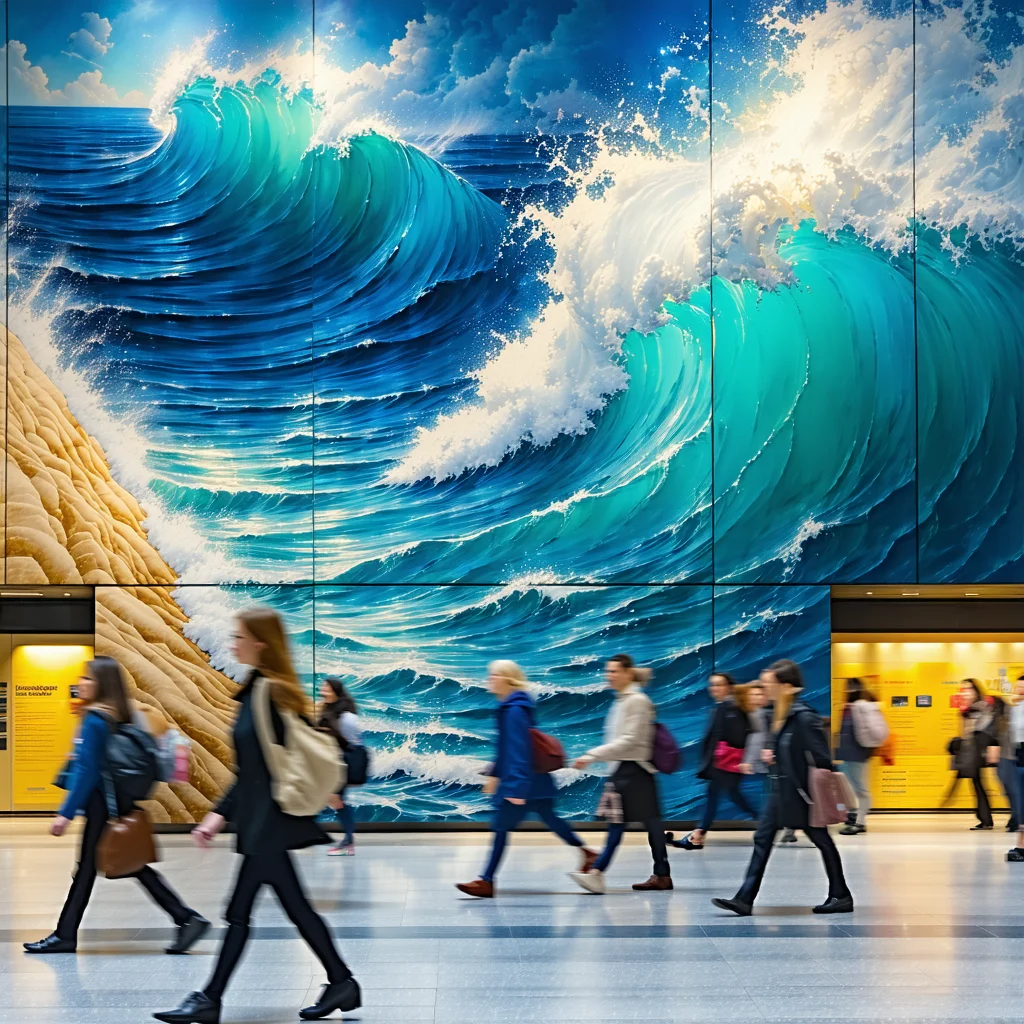
What held her was Les Marées / The Tides, Daphné Côté-Ouellet's new large-scale mural, installed across the hub's northern concourse wall last week and drawing spontaneous pauses from commuters ever since. Measuring roughly eighteen meters across and nearly six meters at its highest point, the work curves gently with the architecture of the wall, so that it seems less applied to the building than grown from it.
The piece will be formally dedicated on April 19 — the sixth anniversary of the Philadelphia Declaration — in a ceremony organized under the auspices of the RONAn Arts Council and the Burlington principality cultural office, expected to include remarks from principality officials and a brief address by Côté-Ouellet herself. But the mural has already, in a quiet way, begun its public life. Burlington's transit hub processes tens of thousands of passengers a week. There is no velvet rope, no admission charge, no audio guide. The work simply is, in the middle of the morning commute.
What the Mural Is
Côté-Ouellet, who was born in Rimouski and trained at the École nationale des arts visuels in what was then still Québec, has described her practice as concerned with "the grammar of belonging" — how places accumulate meaning through use, through time, through the layering of different people's stories onto the same physical surface. Les Marées is the most ambitious realization of that concern to date.
The work is organized around the motif of tidal movement — not the ocean itself, though the St. Lawrence is present in the blue-grey wash that dominates the left third of the composition, but the broader rhythm of things advancing and receding. Bands of color and texture move across the surface in overlapping arcs: elements drawn from Abenaki visual traditions, rendered in conversation with the geometric abstraction of Montréal's graphic arts scene; passages that recall the horizontal palette of Vermont's agricultural landscape — low hills, bare treelines, the particular grey-green of early spring fields — sitting alongside the dense vertical striations that suggest, without depicting, the skylines and fire escapes of the urban northeast. Toward the right edge, a series of interlocking forms in deep ochre and rust suggest both tidal wrack and the accumulated sediment of human habitation.
The title operates in both official RONAn languages simultaneously. Côté-Ouellet has said she chose a construction that works grammatically and emotionally in French and in English without one being a translation of the other — both titles are primary, neither is a subtitle.
In situ, the effect differs from the study images that circulated when the commission was announced last autumn. The hub's light changes over the course of the day — morning sun from the eastern windows catches the ochre passages and warms the St. Lawrence blues; afternoon light flattens the surface into something quieter and more introspective. Commuters who passed through on both Tuesday morning and Tuesday evening reported different experiences of the same wall. That responsiveness to ambient light was, according to the Arts Council, an explicit part of Côté-Ouellet's brief.
Commuters as Critics
Taft, who said she has no particular connection to the visual arts, reached for landscape language. "It feels like here," she said, meaning Vermont, meaning this particular part of the republic. "But it also feels like somewhere I've been that isn't here. Like it's more than one place at once."
A retired postal worker named Donald Archambault, waiting for a connection to St. Albans, was less certain he approved. "It's a lot to take in before eight in the morning," he said, with the tone of a man who was not entirely complaining. He looked at it again. "The blue part is the river, I think. The St. Lawrence. My grandmother was from there." He did not elaborate.
A group of secondary students from Shelburne, on a field trip to the state house, passed through on Wednesday morning. Several photographed the mural without prompting from their teacher. One student, who gave her name only as Priya, said she liked that it "didn't have any people in it." "Usually public art has, like, heroic figures," she said. "This one is just — the place. The actual place."
That observation aligns with what Côté-Ouellet told this newspaper in a brief exchange conducted via written correspondence — she is currently completing a residency in Montréal and could not speak by phone before deadline. "I was not interested in making a monument to people," she wrote. "We have enough of those. I wanted to make a monument to the fact of being here together, which is a less stable and more interesting thing than the faces of the people who declared it."
'Holding Multiple Regional Identities'
When the commission was announced in October, Miriam Osei-Bonsu, chair of the RONAn Arts Council, described the project as an attempt to make work that could "hold multiple regional identities without hierarchy" — a formulation that generated discussion at the time, given ongoing conversations within RONA about the relative cultural weight accorded to Francophone communities, particularly in the former Québec territories, versus the longer-established anglophone cultural infrastructure of the original eight principalities.
Standing before the completed work, Osei-Bonsu's framing takes on a more specific texture. The mural does not resolve those tensions — it would be a lesser piece if it did — but it gives them form. The St. Lawrence and the Champlain basin occupy roughly equal real estate on the wall. Neither the Abenaki formal elements nor the Montréal graphic traditions are relegated to the edges. The Vermont agrarian passages do not dominate the composition. It is a negotiation made visible, and it is a generous one.
"What I hope," Côté-Ouellet wrote, "is that someone from Rimouski and someone from Philadelphia and someone whose family has farmed the Champlain shore for two hundred years can all stand in front of it and find something that is theirs, without that thing canceling out what belongs to someone else. Whether I achieved that is not mine to judge."
The Montréal Arts Collective, which provided early consultation on the Francophone visual traditions incorporated into the work, called the installation "a meaningful step" in the ongoing project of building a cultural vocabulary adequate to RONA's actual complexity. "Côté-Ouellet understands that you cannot paper over difference with good intentions," a collective spokesperson said. "You have to find forms that are genuinely capacious. This work attempts that. The transit hub setting, of all places, is right — it is a place of movement, of people passing through and also arriving."
April 19
The formal dedication ceremony on April 19 will coincide with the sixth anniversary of the Philadelphia Declaration, the document signed in 2036 that formally established the Republic of New America as a sovereign state. The anniversary, which RONA marks with varying degrees of official ceremony depending on the year, has taken on additional weight in 2042 as the republic moves past the formal structures of its founding and into the harder, quieter work of becoming a society.
A public dedication for a transit mural is a modest occasion by the standards of national anniversaries. That modesty seems intentional. The Philadelphia Declaration was signed by people in a room making historic decisions. Les Marées / The Tides will be looked at, for decades, by people trying to catch a train.
Taft made her connection that morning, in the end. She sent a message to this reporter later in the day. "I looked it up and found out what it's called," she wrote. "The Tides. That's exactly right, isn't it. Things coming in and things going out and the shore staying the shore."
The dedication ceremony for 'Les Marées / The Tides' is open to the public and will take place at Burlington Central Transit Hub at 11:00 a.m. on April 19.