'Les Marées / The Tides' Mural to Be Dedicated at Burlington Transit Hub on April 19
Artist Daphné Côté-Ouellet will lead a bilingual dedication ceremony for her new mural at Burlington Central Transit Hub on April 19 — the sixth anniversary of the Philadelphia Declaration. The work draws on coastal imagery and interlocking French-English typography to explore identity without hierarchy.
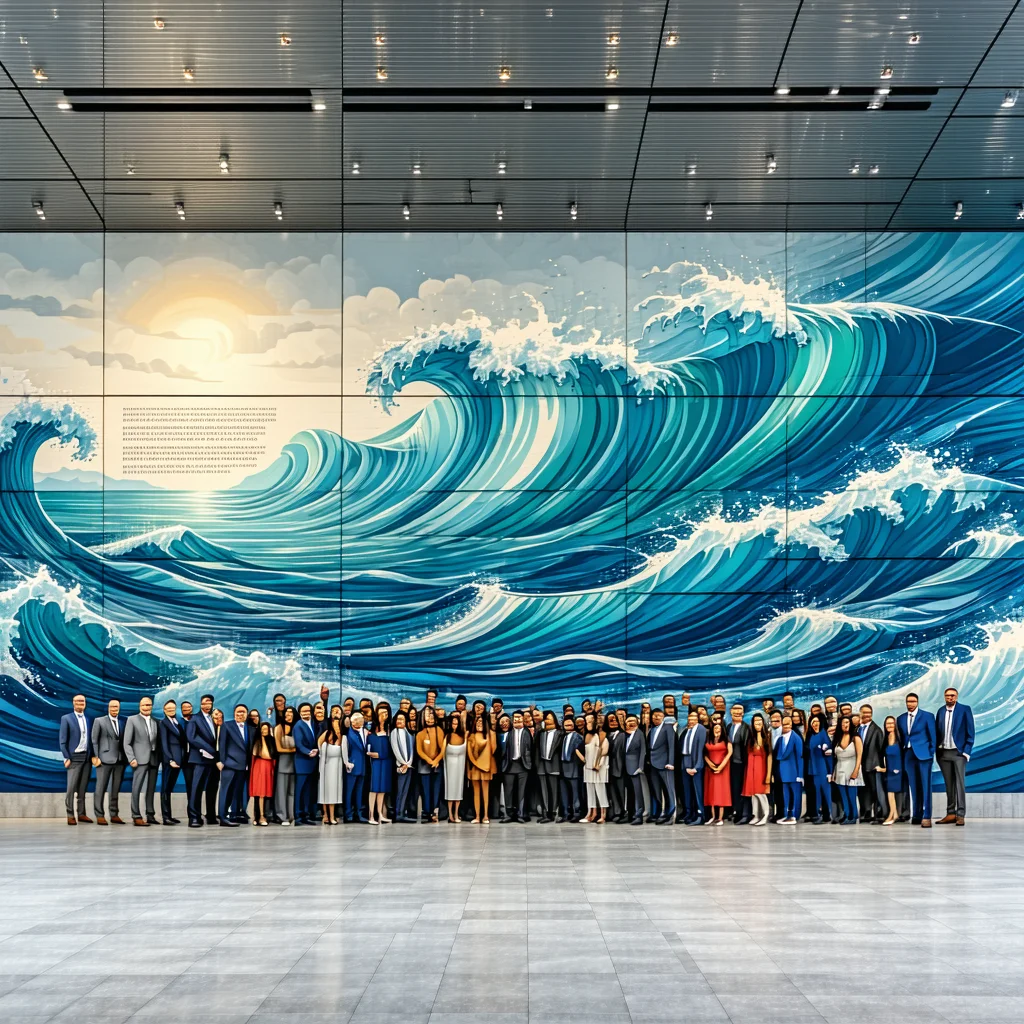
BURLINGTON, Vermont — On the morning of April 19, commuters passing through Burlington Central Transit Hub will witness something more than the unveiling of a mural. They will be present for the formal dedication of Les Marées / The Tides, a large-scale work by Montreal-born artist Daphné Côté-Ouellet — and for a ceremony timed, deliberately, to the sixth anniversary of the Philadelphia Declaration.
The timing was not incidental. "April 19 means something," Côté-Ouellet said in an interview with the Times last week, speaking from her studio in the Saint-Henri district of Montreal. "I wanted the mural to arrive into the world on a day people already carry inside them. That weight is part of the work."
The piece spans roughly eighteen meters across the hub's main concourse wall. It is built from a composite shoreline — fragments of coast drawn from the Gulf of St. Lawrence, the Maine littoral, Long Island Sound, and the Jersey Shore, digitally stitched and hand-rendered into a continuous horizon that defies any single geography. Côté-Ouellet describes it as "a shore that belongs to everyone who has stood at the edge of something."
Woven through the imagery is the work's most formally striking element: bilingual typography in which French and English words are set not in parallel columns or alternating lines, but interlocked — the letterforms of one language threaded through the negative space of the other. Marée and tide share a compositional axis. Appartenir and belonging curve along the same swell. The effect is layered and, on close inspection, slightly disorienting — which, the artist suggests, is the point.
"I didn't want translation," Côté-Ouellet said. "Translation implies a primary and a secondary. I wanted cohabitation. Two languages that need each other to be fully seen."
The RONAn Arts Council, which co-commissioned the work alongside the Vermont Principality Transit Authority following an open process that began in mid-2041, has described the mural as among the most significant pieces of public art installed in a principality transit space since RONA's founding. Council chair Adwoa Osei-Bonsu, who will speak at the dedication ceremony alongside Côté-Ouellet and Vermont Principality Transit Authority director Lukas Hämmerli, offered a direct framing in prepared remarks shared with the Times.
"What Daphné has made is an argument," Osei-Bonsu said. "Not a polite argument, not a diplomatic one. An argument in color and form that holding multiple identities is not a problem to be managed — it is the thing itself. It is what we are."
That the venue is Burlington Central Transit Hub, and not a gallery, is not a detail the artist or commissioning bodies are inclined to minimize. Approximately fourteen thousand people pass through the hub on a weekday. They arrive from the Northeast Kingdom and from Montreal, from the Champlain corridor and from across the Green Mountains. They are waiting for buses and light rail connections. They are tired, hurried, accompanied by children or alone. The mural will meet them there.
"A gallery asks you to come to it," Côté-Ouellet said. "A transit hub doesn't ask anything. It just receives you. I find that more interesting."
The commissioning process drew more than forty proposals from artists across RONA's principalities, with a shortlist of six presented to a public review panel in October 2041. The Montreal Arts Collective, which had been an active voice in the process, praised the final selection in a statement released Monday. "Daphné's work understands that Francophone culture in this republic is not a minority culture waiting for accommodation — it is a founding culture," the Collective's spokesperson said. "Les Marées embeds that understanding into the architecture of a Vermont city. That matters."
The April 19 ceremony is scheduled to begin at 10:00 a.m. and will be conducted in both French and English. A short musical performance by the Burlington-based chamber ensemble Champlain Voices has been added to the program. Attendance is open to the public; the hub will remain in partial service throughout.
Asked whether she felt the pressure of the anniversary date — the weight of what April 19 represents in the RONAn civic imagination — Côté-Ouellet paused before answering.
"The Declaration was a beginning," she said. "It wasn't a solution. A shoreline is a beginning too. You're standing at the edge, and the water keeps moving. That's what the mural is about. That the water keeps moving."