'Les Marées / The Tides' Unveiled in Burlington as a Nation Marks Six Years
Artist Daphné Côté-Ouellet's sweeping bilingual mural was unveiled Friday at Burlington's Central Transit Hub, arriving five weeks before the sixth anniversary of the Philadelphia Declaration. The work is monument, mirror, and transit art — but first it is simply beautiful.
BURLINGTON, Vermont — March 23, 2042
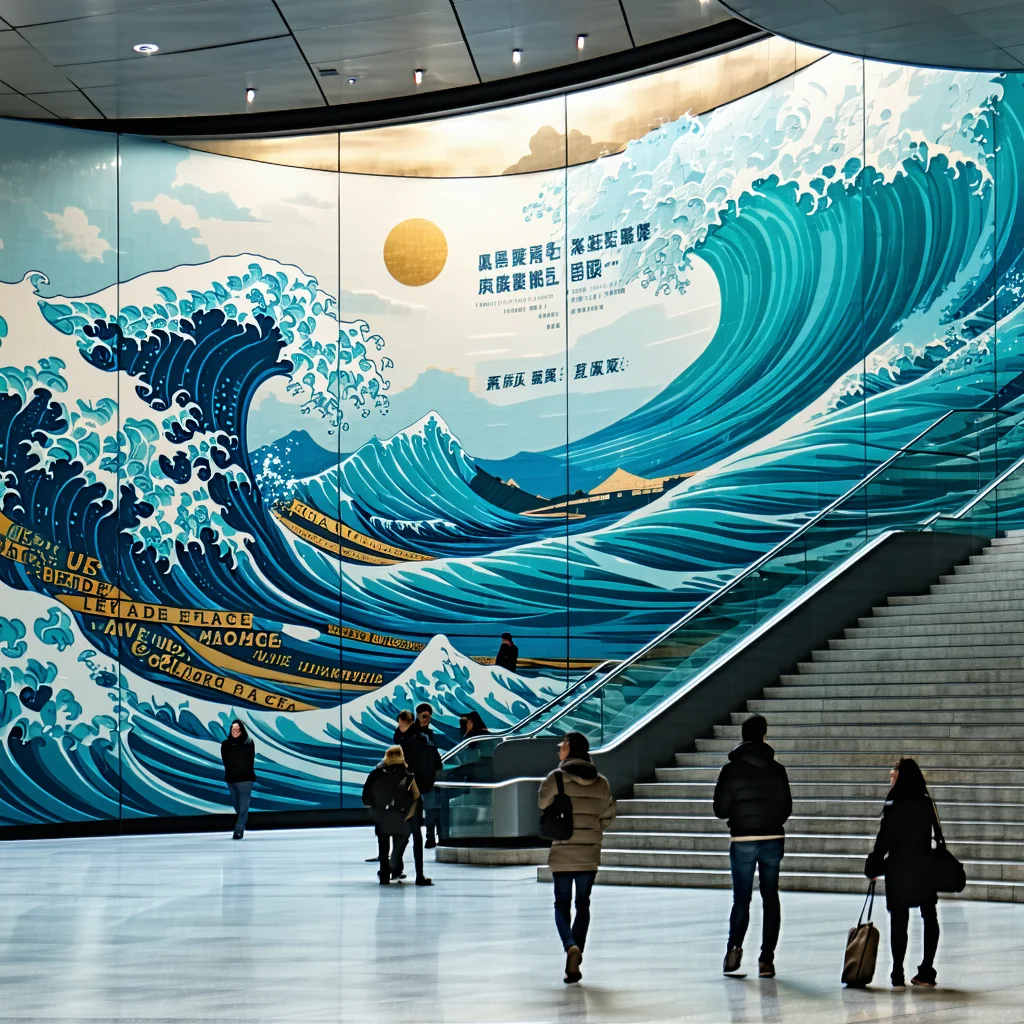
Stand in the main concourse of Burlington's Central Transit Hub at seven in the morning, when the light comes low and grey through the east-facing clerestory windows, and the mural will find you before you find it. The blues arrive first — deep Atlantic blue bleeding into the pewter of receding tide — and then, as your eyes adjust, the words begin to surface. Not slogans. Not declarations. Words the way water moves: overlapping, inseparable, neither one drowning the other.
Les Marées / The Tides, the new large-scale mural commissioned by the RONAn Arts Council and unveiled Friday evening, stretches nearly thirty meters across the hub's curved western wall. Its creator, Montreal-based artist Daphné Côté-Ouellet, was present for the unveiling — quiet amid the gathered crowd of commuters, officials, and students from Burlington Arts College who had been tracking the installation for weeks through gaps in the scaffolding.
"I wanted people who are going to work to feel it," Côté-Ouellet said afterward, speaking in the careful bilingual cadence that has become something of a signature in her public interviews. "Not to stop and read a plaque. To feel something before they have had their coffee."
The work repays careful looking. At its center, the two languages of RONA's official life are rendered not in parallel columns or neat alternation but in genuine interlocking: the ascender of a capital L in Les threading through the crossbar of a T in The, the word marée breaking across a wave crest to emerge, on the other side, as tide — not translated so much as transformed, the way a word changes when it crosses a border. The typography is Côté-Ouellet's own design, developed over eighteen months; it has no name yet, though she says she has been calling it, privately, confluent.
The palette moves from deep ocean at the left edge — a blue-green so saturated it reads almost as black in certain light — through gradations of grey-green, sand, and finally, at the far right, a narrow strip of what can only be described as early morning: pale gold, barely there, a horizon promising something it will not yet show you.
"Daphné's proposal stood out from the beginning because she refused to illustrate the nation," said Kwame Osei-Bonsu, chair of the RONAn Arts Council's public works committee, speaking at the unveiling. "A lot of the submissions we received wanted to show RONA to itself — maps, flags, faces. Daphné gave us something you can't reduce to a symbol. You have to be in front of it. You have to let it work on you."
Osei-Bonsu confirmed that the commission was not explicitly tied to the sixth anniversary of RONA's formal recognition, now five weeks away, though the timing was not accidental. "We wanted something ready for the spring," he said. "This spring carries weight. We knew that."
The spring of 2036 — when Quebec and parts of Ontario joined the nascent republic amid the upheaval that followed Canada's fragmentation, and when RONA's formal recognition arrived — remains the constitutive moment of this nation's legal existence. Six years on, its anniversary has accumulated the slightly uneasy energy of all young countries' founding myths: part celebration, part ongoing argument about what, exactly, was founded. Les Marées / The Tides does not enter that argument. It stands beside it.
What the mural insists on, above everything, is the coexistence of French and English not as a political settlement but as a natural fact — the way two currents occupy the same water. Côté-Ouellet grew up in Rimouski, spent a decade in New York before RONA's establishment, and has lived in Montreal since 2037. She moves between languages in daily life the way most Montrealers do: not switching so much as breathing.
"People ask me which language the mural is in," she said. "I tell them: stand in front of it. Which language is the tide in?"
The Montreal Arts Collective, which has championed Côté-Ouellet's public work since her Embouchure installation at Parc La Fontaine four years ago, issued a statement Friday calling the unveiling "a milestone for Francophone cultural presence in the principalities" — a phrase that carries its own political freight, spoken quietly.
Burlington's Central Transit Hub serves approximately forty thousand passengers on a typical weekday: commuters on the Champlain rail corridor, cross-principality buses, freight workers starting shifts before dawn, students. It is, in other words, a democratic space — one of the few places where a piece of commissioned public art is guaranteed to be seen by people who did not choose to see it. Côté-Ouellet knows this. She designed the mural to be legible at speed, from the corner of an eye, from across a crowded concourse.
"Museum art is for people who are ready," she said. "Transit art has to earn it. I like that pressure."
Whether Les Marées / The Tides earns it will ultimately be judged by the forty thousand, not the critics. On Friday evening, with the scaffolding barely cold and the cleaning crew still sweeping plaster dust from the concourse floor, it was already drawing people to stop and simply look — which, in a transit hub, is no small thing.
The mural will be officially dedicated at a public ceremony on April 19, timed to the anniversary. Côté-Ouellet said she plans to attend but will not speak at the ceremony.
"The work will speak," she said. "That is enough."