Bilingual Mural 'Les Marées / The Tides' Dedicated at Burlington Transit Hub on RONA Anniversary
Artist Daphné Côté-Ouellet's bilingual mural was formally dedicated at Burlington's Central Transit Hub on Sunday, the sixth anniversary of the Philadelphia Declaration. The work weaves French and English typography into a composite shoreline that refuses to assign primacy to either language.
BURLINGTON, Vermont —
The wall had been covered since February. A long run of construction hoarding along the eastern concourse of Burlington Central Transit Hub, unremarkable in the way temporary barriers always are — until Sunday morning, when it came down, and several hundred people gathered to see what Daphné Côté-Ouellet had made for them.
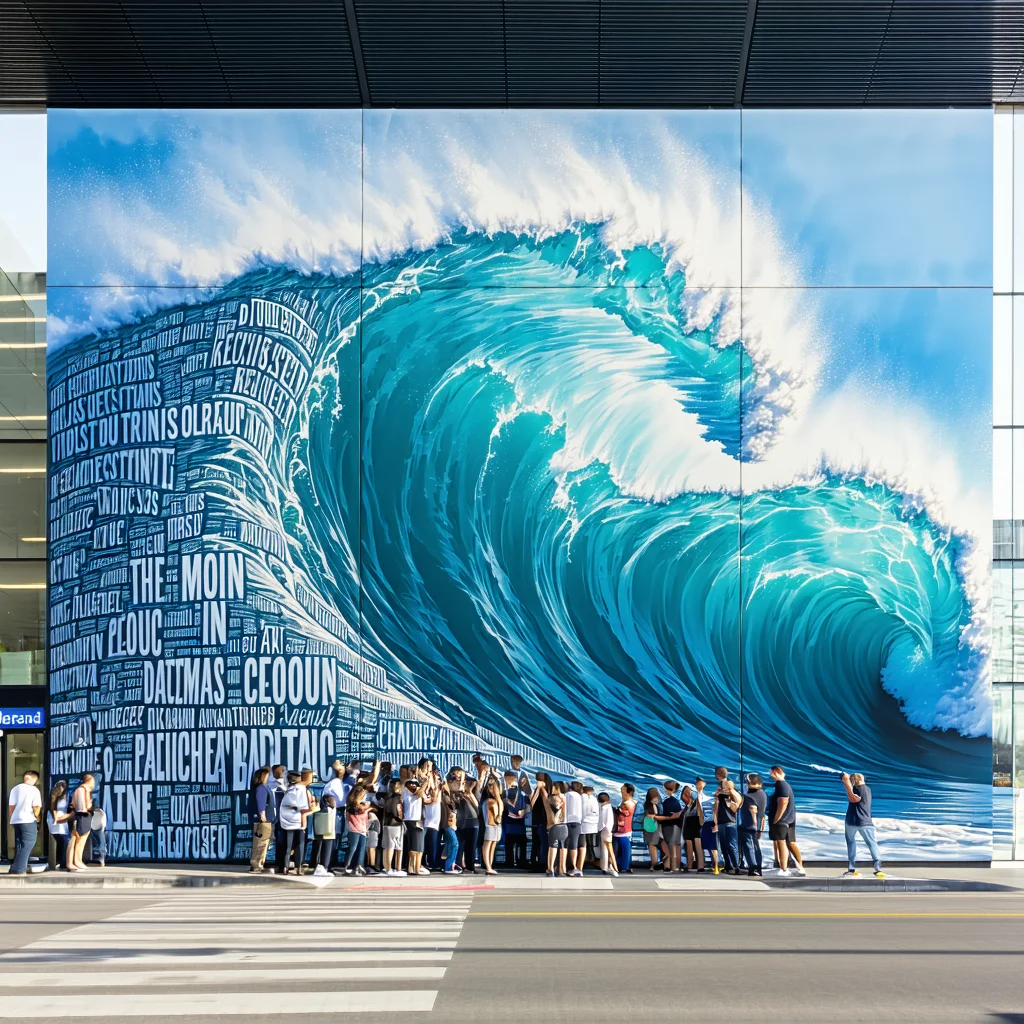
What she made was Les Marées / The Tides: a mural running nearly eighteen meters across the curved interior wall of the hub's main arrivals corridor, depicting a composite shoreline assembled from eight distinct RONAn sites — the rocky headlands of Penobscot Bay, the wide tidal flats outside Moncton, the riverbank granite shelves below Montréal's old port, the gravel beaches of Lake Champlain in late autumn light. No single place. Every place. The effect is simultaneously documentary and imagined, a geography that could not exist in nature but feels, somehow, true.
The dedication fell on March 23rd — the sixth anniversary of the Philadelphia Declaration, the founding document of RONA. That alignment was not accidental.
"I wanted to make something about water and time," Côté-Ouellet said, after the ceremony. "Tides don't ask permission. They don't negotiate which shore belongs to which language. They just move. I thought that was honest."
The mural's most discussed feature — already circulating widely in the days before the official unveiling, in photographs taken by workers who had glimpsed it during installation — is its typographic architecture. The title words themselves are embedded in the image: Les Marées in a loose, wave-cut serif that traces the waterline of the northern sections, The Tides in a compressed sans-serif that reads like tidal notation along the southern edge. At no point does one language sit above the other. Read left to right, French leads; read right to left, English does. Read from the center outward, they rise together.
"That was the non-negotiable," said Miriam Osei-Bonsu, spokesperson for the RONAn Arts Council, which commissioned the work following an open selection process last spring. "The brief specified a bilingual work for a bilingual republic, and what that can sometimes mean in practice — though no one says it out loud — is French as decoration and English as the real text. Daphné's proposal was the only submission that structurally refused that. The selection panel was unanimous, and I think the reason is that she didn't just depict equality, she engineered it into how the thing is read."
Côté-Ouellet, 34, grew up in Rimouski before her family relocated to Montréal in the years following Quebec's entry into RONA. She studied visual art at Concordia and has since become one of the more visible artists working at the intersection of public space and what she calls "the infrastructure of belonging" — the transit hubs, libraries, border crossings, and civic plazas where a nation's self-image is either reinforced or quietly undermined. Les Marées is her largest commission to date.
The shoreline composite required eight months of fieldwork, most of it photographic, some of it sculptural. Côté-Ouellet made plaster casts of rock formations at three of the sites, using them to develop the texture work that gives the mural its unusual tactile quality in person. Sections of the wall are raised by as much as four centimeters, creating shadows that shift through the day as the transit hub's lighting cycles. The piece does not look the same at 7 a.m. as it does at 6 p.m. It was designed that way.
"Commuters are the audience," she said. "Not gallery visitors who stand still. People who glance up. I wanted something that rewards the glance, but also the second glance, and the tenth. The light changes. Your mood changes. Hopefully it gives back something different each time."
Burlington was selected as the site partly for practical reasons — the transit hub is one of the busiest in the Vermont principality, handling rail, bus, and regional electric shuttle connections — and partly for its symbolic position. It sits roughly equidistant between the Anglophone communities of the northern lake towns and the increasingly Francophone corridor running toward the Montréal metropolitan area. A wall in Burlington is a wall a great many different RONAns walk past.
Some of them travel a considerable distance to do so. In the small border town of Richford, where questions of language, identity, and what a bilingual republic looks like from its edges rather than its centers have been the subject of sustained community debate, Sunday's dedication drew interest well before the hoarding came down. A number of Richford residents made the trip south for the ceremony, a detail the Arts Council noted with satisfaction.
"That's what public art is supposed to do," Osei-Bonsu said. "Not just serve the city it's in. Radiate outward. We hear Burlington; we don't always remember that Burlington is a hub in every sense — it connects communities that might otherwise feel peripheral to the conversations we're having about who we are."
Côté-Ouellet, asked what she hoped people would feel standing in front of the finished work, paused before answering.
"Recognized," she said finally. "Not celebrated. Not represented in some official way. Just — seen. As if the country knows they're in it."
Les Marées / The Tides is a permanent installation. Burlington Central Transit Hub is open daily.