The Taste of a New Country: How RONAn Culture Is Finding Its Shape
Six years after the Philadelphia Declaration and five years after Montreal joined the Republic, a distinct RONAn culture is emerging from the fusion of northeastern American and Québécois life — one that is bilingual, improvisational, and stubbornly human.
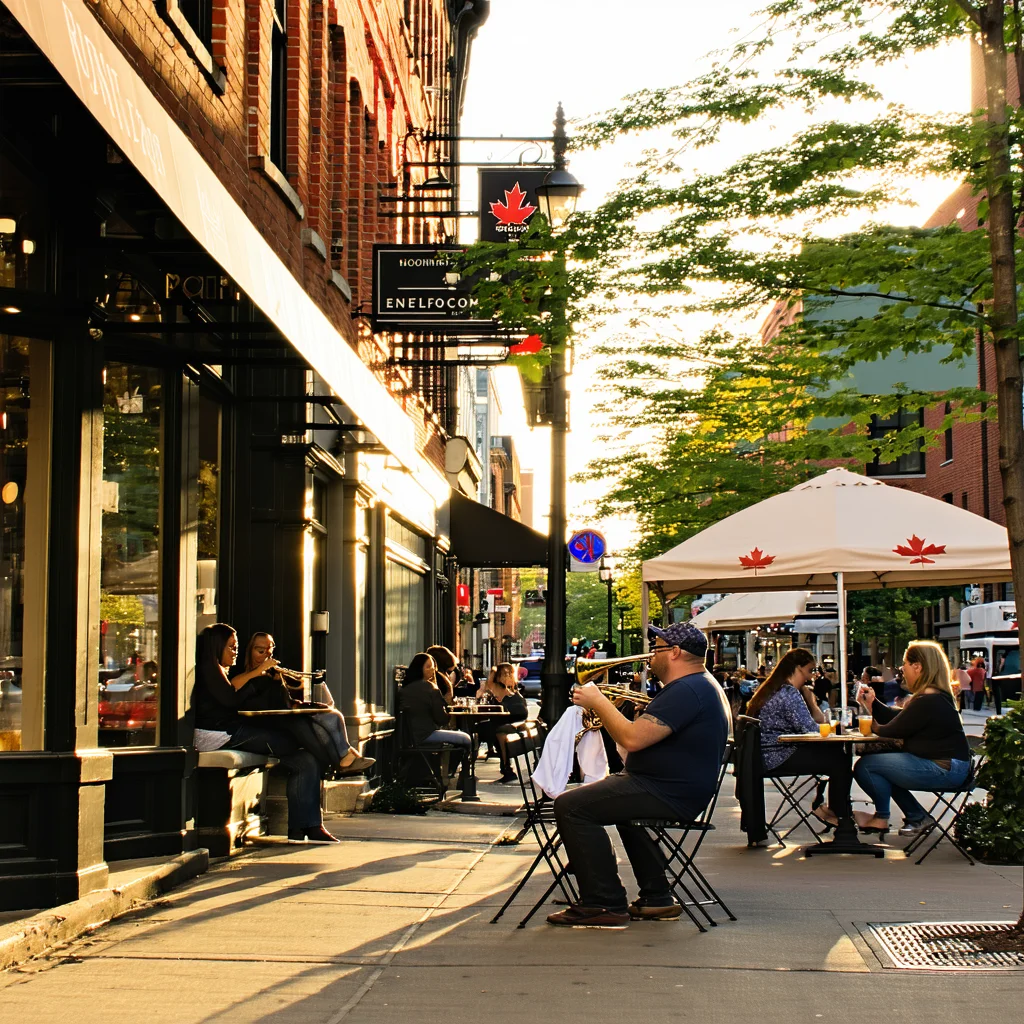
MONTREAL — March 2042
The sugar maple does not care about borders. It never did. Long before the Philadelphia Declaration remade the map of North America, the maple forests of Vermont and southern Quebec shared the same geology, the same freeze-thaw rhythms, the same slow sweetness pooling in buckets on a cold March morning. It is fitting, then, that the maple has become something close to an unofficial symbol of the Republic of New America — not by any government decree, but by the quieter democratic process of people simply deciding what matters to them.
On a Tuesday morning in late February, Geneviève Boivin-Racette, 54, is standing in her sugarhouse in the Northeast Kingdom — the old Vermont designation that has survived every political transformation and, she says, will outlast several more — watching sap drip through a filtration rig her grandfather built and she has since wired for remote monitoring. The air smells of woodsmoke and something almost medicinal, clean. She speaks in French, then catches herself, then doesn't bother catching herself anymore.
"Je dis les deux maintenant," she says. I say both now. "Five years ago I was nervous to speak French at the Newport market. Now I do it and people respond, or they don't, or they ask me to slow down. It's fine either way. Something has relaxed."
Boivin-Racette was born in Sherbrooke but has lived in the Northeast Kingdom for twenty-two years. She arrived before any of this — before the secession referendum, before the Philadelphia Declaration, before the slow, fractious, eventually successful negotiation that brought Quebec into RONA in March 2037. She was already, in some sense, what her neighbors are only now becoming: a person who lives between languages, between food cultures, between versions of the same northern landscape.
"People ask me, what does it feel like to finally be in the same country as my cousins in Drummondville?" she says, laughing. "I tell them it feels like someone finally noticed what was already true."
Building the Vocabulary of a Nation
What does it mean to be RONAn in 2042? The question is everywhere — in podcasts and political speeches, in school curricula and restaurant menus, in the lyrics of songs that are starting to sound, faintly but perceptibly, like something new. It is a question asked with anxiety by those who worry about what has been lost, and with excitement by those who are young enough to experience the republic's newness not as rupture but simply as home.
The Republic of New America is six years old as a sovereign state, five years old in its current geography. It is, by any historical measure, an infant nation. And yet the work of building a shared culture — always slower and stranger and more organic than any official can plan — is visibly underway. The ingredients are remarkable in their variety: the civic traditions of Massachusetts and Pennsylvania, the agricultural rhythms of Vermont and the St. Lawrence Valley, the Haitian and West African and Southeast Asian diasporas of Montreal, the working-class industrial heritage of New Jersey, the Indigenous nations whose presence predates every flag. What is crystallizing from this mixture is not a melting pot — that old American metaphor has been consciously retired — but something more like a pot-au-feu: distinct flavors coexisting in the same broth, each changed by proximity to the others, none dissolved.
"We specifically rejected the assimilationist model," says Diane Beausoleil-Chang, the communications director for the Montreal Arts Collective, reached by video from her office in the Plateau-Mont-Royal neighborhood. "The RONAn constitutional framework protects linguistic and cultural specificity in a way the old Canadian model gestured toward but often failed to deliver. Whether we can actually live up to that in practice — that's the question we're answering every day."
The Collective, which represents Francophone cultural producers across the principality of Quebec, has been at the center of both the anxieties and the optimism of this moment. Its member organizations received a significant increase in RONAn federal arts funding last year — a point of pride for some and a source of suspicion for others, who wonder whether federal money comes with federal expectations.
"We watch carefully," Beausoleil-Chang says. "Support is welcome. Influence over content would not be."
The Music of the Seam
In a rehearsal space above a hardware store on the Rue Saint-Denis, a six-piece band called Lignes de Faille — Fault Lines — is running through a set that could not have existed a decade ago. The drummer, Marcus Webb-Thibodeau, grew up in Burlington. The fiddle player, Inès Okafor, was born in Pointe-Saint-Charles to parents who came from Cameroon. The lead vocalist, Stéphanie Paradis-Nguyen, is from Rimouski but spent three years busking in Philadelphia before returning north after the Declaration. They play something their fans call fracture folk — a genre name that arrived on social media before anyone in the band had thought to name it — drawing on Appalachian fiddle traditions, traditional Québécois trad, and the kind of percussive minimalism that traces a line back through Montreal's Haitian jazz scene.
"It's not a fusion project," Paradis-Nguyen says firmly, during a break. She is drinking what appears to be an extremely large coffee. "We're not trying to blend things together into one thing. It's more like — we're all just playing from where we're from, and it turns out those places are closer than anyone thought."
Webb-Thibodeau nods. "I grew up listening to contra dance music. My mom's family has been in Vermont since before Vermont was Vermont. And when I got here and started playing with Stéph, I realized the gigue and the Appalachian reel are basically cousins. Different accents. Same grandmother."
Lignes de Faille played forty-two shows last year, from Halifax to Philadelphia. Their most-streamed song, "Ligne de partage / The Watershed," is sung in alternating French and English, with a chorus that shifts between languages mid-phrase. The song is about the Connecticut River. It spent eleven weeks on the RONAn independent music chart and crossed over briefly into European streaming playlists, where it was categorized, with understandable confusion, as "North American folk."
"That's accurate," Paradis-Nguyen says. "We are North American. We're just not the North Americans people expected."
The Poet at the Seam
Josué Beaumont-Pierre is 29 years old and has been writing poetry in English for his entire adult life, a choice that has by turns baffled, offended, and delighted different segments of his audience. He was born in Montréal-Nord to parents who came from Port-au-Prince in the 2020s, and grew up speaking Haitian Creole at home, French at school, and English in the music he loved. He now writes a column for an online literary journal published out of Burlington, teaches a poetry workshop at UQAM, and is working on his second collection.
His first collection, Neither Shore, published in 2040, won the inaugural RONAn Literature Prize — an award that, as several reviewers noted, could not have existed when the poems in it were written.
"People ask why I write in English," he says, sitting in a café in Rosemont, a neighborhood of older brick triplexes and newer bioclimatic retrofits, where the menu board is in French, the barista greeted him in Creole, and the couple at the next table is conducting what sounds like a business meeting in Mandarin. "I tell them: the language chose me, not the other way around. The hip-hop I grew up with was in English. The writers who cracked me open — Baldwin, Morrison, Rankine — wrote in English. That's the river I swim in."
He pauses. "But I think in French. And I dream in Creole. So what you get is English that has been somewhere else."
That quality — English that has been somewhere else — is audible throughout his work. His poem "Accession," which responds obliquely to Quebec's entry into RONA, has been reprinted in three anthologies and set to music twice. It ends with a stanza that has become, quietly, something people cite when they are trying to explain to outsiders what this country feels like from the inside:
We are not the flag they planted
nor the ground they planted it in.
We are the argument
still being made,
in every tongue at once,
about what ground is for.
"I didn't think of that as a political poem when I wrote it," Beaumont-Pierre says. "I thought of it as a poem about my parents. About what it costs to arrive somewhere and be expected to become someone else. But I suppose that's what politics is, in the end. The personal argument at scale."
The Children Who Don't Remember
In Island Pond, Vermont — a small town in the Northeast Kingdom where winters are unforgiving and the population has grown roughly 30 percent since 2037, largely from Québécois families who moved south for work in the bioregional forestry cooperatives — there is a middle school that offers instruction in both English and French, depending on the subject. Math and science are taught in English. History and éducation civique are taught in French. Physical education, one teacher explains, is conducted primarily through shouting and is therefore multilingual by necessity.
Mireille Tanguay-Scott is thirteen years old. Her mother is from Thetford Mines; her father's family has been in Island Pond for four generations. She was nine years old when Quebec joined RONA, and has no memory of a time before the Republic existed.
"My grandpa talks about 'the United States' like it's still a thing that happened to him," she says during a lunch break, eating a sandwich that turns out to be a hybrid of a croque-monsieur and something approximating a club — ham, Swiss, mustard, a leaf of something green she identifies as "from the greenhouse." "But I've never been there. I've never been anywhere, really, except Montreal once for a school trip. But I know we're something different than that. We're RONA."
What does that mean to her?
She considers. "It means we vote. It means we say what language we want. It means if the Americans do something bad to us, the Europeans get mad." A pause. "And it means maple season, probably."
Her friend, Kwame Adjei-Peltier — born in Montreal, moved to Island Pond three years ago, father from Ghana, mother from Abitibi — adds: "It means we're supposed to figure it out ourselves. Like, no one's handing us a finished country. We're building it."
He says this without apparent anxiety. It sounds, coming from him, like a simple statement of fact.
Food as Civic Act
Every new nation eventually develops its food. The United States had its barbecue mythology and its apple pie nationalism. France has its cheeses, its regulated appellations, its endless arguments about what counts as authentic. RONA, still young enough to be self-conscious about these things, is in the early and genuinely interesting phase of figuring out what it eats.
The official answer, which no one much credits, is something vague about "regional diversity." The actual answer, observable to anyone who spends time in RONAn kitchens, restaurants, and farmers markets, is more specific and more interesting: it is a cuisine organized around the short northern growing season, around fermentation and storage and root vegetables, around the traditions of French Canadian cuisine du terroir and New England farmhouse cooking, shot through with the flavors of diasporas that have been here for generations and those that arrived more recently.
At the Marché du Plateau in Montreal on a Saturday morning, a vendor named Thierry Côté-Beauchamp sells a hot sauce made from Québécois peppers and spiced using a technique he learned, he says, from "my neighbor, who is from Trinidad and has been teaching me for six years." Next to him, a stall run by a family from the Penobscot Nation sells dried wild blueberries alongside a blueberry preserve developed in partnership with a jam cooperative in the Eastern Townships.
"People want to know what RONAn food is," Côté-Beauchamp says, handing a sample cup to a customer. "I always say: this is. This moment, right here. You asking, me answering, both of us trying it."
The Vermont Principality Department of Agriculture issued guidance this week on maple sap storage protocols for the early-running 2042 season — a sign of a warm late winter. It is a reminder that maple remains one of the few agricultural products that genuinely spans the new geography: the syrup belt runs continuously from Vermont through the Eastern Townships and up into the Laurentians, a landscape of shared flavor that preceded any political arrangement.
Boivin-Racette, back in her sugarhouse, is philosophical about what her product now represents.
"The maple doesn't know it's RONAn," she says. "But the people buying it do. They buy it because it's from here. And 'here' means something it didn't used to mean."
The Civic Rituals, Incomplete
Nations need their rituals. They need their days, their songs, their ceremonies. RONA has Declaration Day on January 15th — the anniversary of the Philadelphia Declaration — which is marked with varying degrees of solemnity depending on where you are. In Philadelphia, there is a formal ceremony in front of the hall where the declaration was signed; in Montreal, there is a ceremony and then, almost immediately, an argument about whether the ceremony is too Anglophone in its symbolism.
The argument is, in its way, one of RONA's more reliable civic traditions.
"We fight about what it means to celebrate," says Sophie Lapointe-Rousseau, a community organizer in Verdun who runs a neighborhood civic center offering French-English conversation exchanges, shared cooking classes, and, during hockey season, what she describes as "a completely unstructured space to yell." "I think that's fine. The fighting is democratic. The fighting is the point."
She is organizing, this spring, a block-level "fête de quartier" that she intends to run bilingually, featuring music from local musicians, food from a rotating list of neighborhood cooks, and a structured conversation exercise she is calling "Le Récit / The Story" — an invitation to residents to share, in whichever language they prefer, something about where they come from and what they brought with them.
"We are building a shared story," she says. "But it has to be built out of all the individual stories. You cannot skip the individual stories. You cannot manufacture the shared one. You can only make space for it and hope."
From a second-floor window of the civic center, you can see, across the street, a wall mural painted last summer by a collective of young artists from six different neighborhood backgrounds. It depicts the St. Lawrence River flowing into the Gulf, with the Green Mountains visible in the background through some cartographic implausibility that has delighted rather than bothered everyone who sees it. At the bottom, in both languages, unattributed, a single line:
Nous construisons. / We are building.
The paint is barely a year old. It already looks like it has always been there.