'We Are RONA': A Student Podcast Searches for the Nation's Everyday Voice
A bilingual podcast from McGill University asks ordinary RONAns — not officials or analysts — what it means to belong to a six-year-old country. The answers are complicated, honest, and occasionally moving.
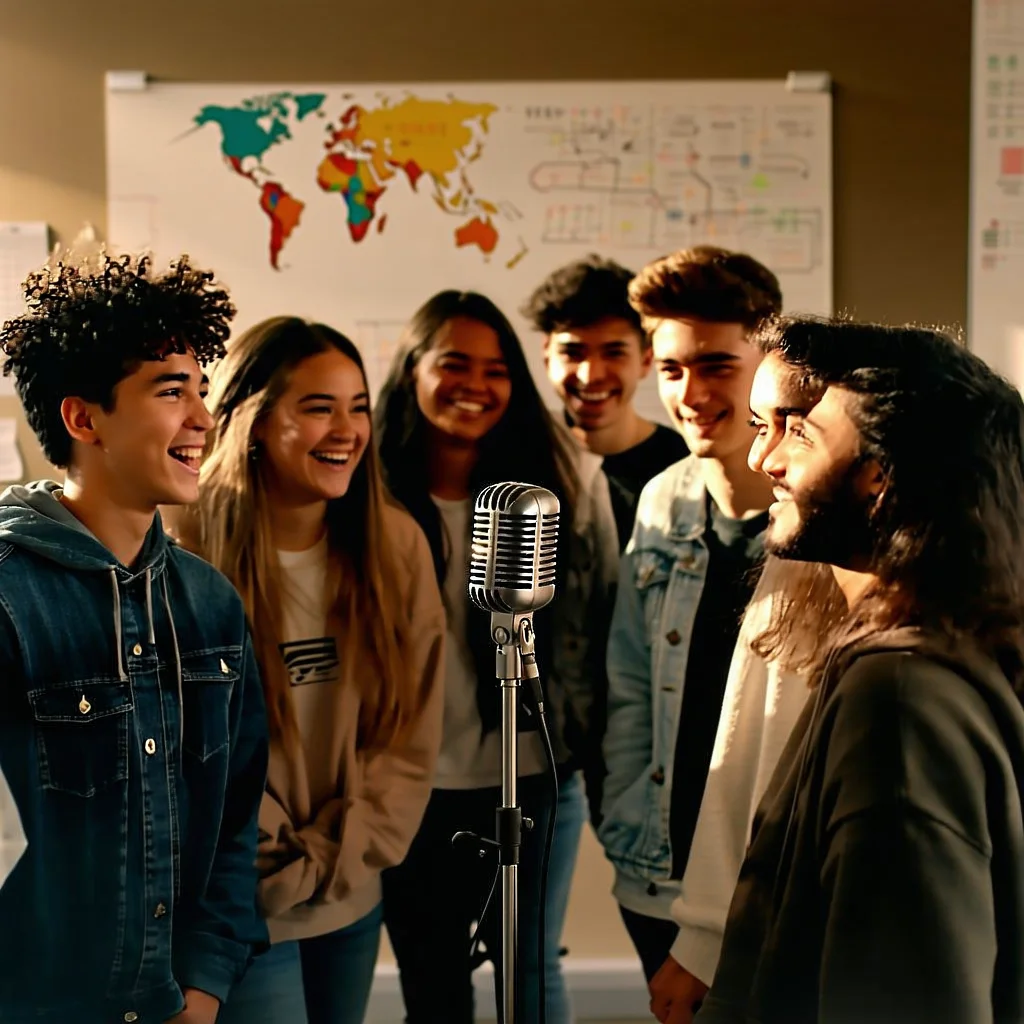
MONTREAL — The third episode of Nous Sommes RONA / We Are RONA opens with the sound of a barn door. You hear wind, the low complaint of cattle, boots on frozen ground. Then Étienne Bouchard, a dairy farmer from the Vermont principality's Northeast Kingdom, says something in French-accented English that is likely to stay with you: "I didn't vote for a new country. I voted against a country that had already left me."
It is a good line, and a complicated one — and the student collective behind the podcast, based at McGill University in Montreal, seems to understand exactly why. They let it sit in the air for a long moment before the host, second-year political science student Camille Trépanier, asks a gentle follow-up: "And now? Six years later? Do you feel like this one has stayed?"
Bouchard's answer runs nearly four minutes. He talks about the Vermont principality's agricultural subsidy program, which he calls "real, if slow." He talks about his daughter, who studies renewable systems engineering at UVM and isn't sure she'll come back to the farm. He talks about a Quebec neighbor who moved across what used to be a border and now farms the land next to his. "He speaks French and I speak bad French," Bouchard says, laughing. "But we both know how to move a fence line."
This is what Nous Sommes RONA / We Are RONA is doing, three episodes in: finding the places where national identity is not declared or theorized but quietly, practically negotiated. The series is modest in scope — the production quality is clean but not polished, the listenership small by any commercial measure, somewhere in the low thousands across both language streams — but it has already attracted enough attention to be shared by several principality cultural offices on their public channels. The Vermont Principality Arts Office linked to the Bouchard episode without comment, which in the restrained culture of Vermont officialdom counts as enthusiasm.
The project was conceived, Trépanier explains in a video call, as a direct response to what she describes as "the exhaustion of the official story." She means the founding mythology of RONA: the Philadelphia Declaration, the EU-China guarantee, the principalities joining hands across old state lines. "Every anniversary, every commemoration, we hear the same voices," she says. "Senators. Council members. Academics. I wanted to know what the people who weren't in the room think about the room."
Her co-host and co-producer is Kwame Asante-Diallo, a third-year student from Montreal's Plateau-Mont-Royal neighbourhood whose parents came to what was then Canada from Ghana in the late 2020s. He handles the French-language interviews and much of the audio editing. "My family's relationship to this country is not the same as someone whose grandparents were born in Massachusetts," he says. "But we're RONAn now too. I wanted to hear from people whose story is also not the simple story."
The first episode — the one that established what the show would be — features Denise Kowalczyk, a former steelworker from the Bethlehem, Pennsylvania area who now works at a renewable manufacturing plant in the Lehigh Valley, one of the facilities that came online after the RONA-EU trade partnership began driving investment into the principality's industrial corridor. She is not, she makes clear immediately, sentimental about the transition. "I lost fifteen years of seniority when the old plant closed," she says. "I got a retraining stipend that covered about a third of what I actually needed. I'm not going to pretend that was easy."
But she stays. She talks about what staying means, which turns out to be a long conversation about her block in Bethlehem, about her church, about the RONAn football league's expansion team that she follows with the specific, slightly ironic devotion of a person who knows sport is not the point but finds the point there anyway. By the end of the episode, she hasn't resolved anything. "I'm a RONAn because I live here," she says. "Whether that means something, I guess we're still finding out."
The Montreal Arts Collective, which works closely with the city's francophone cultural sector, has taken note. "What this podcast is doing is genuinely rare," a collective spokesperson said. "It's not celebrating. It's not complaining. It's just listening. That is, honestly, harder than it sounds in this moment."
The moment they are referring to is the building atmosphere around the sixth anniversary of the Philadelphia Declaration, which falls in mid-January but whose cultural resonance tends to unspool across the early months of the year. Burlington has been particularly active, with commemoration events threading through the winter arts calendar. The Nous Sommes RONA team is aware of the anniversary context but has chosen, deliberately, not to centre it.
"Everyone will do the anniversary piece," Trépanier says, not unkindly. "We're not interested in the anniversary. We're interested in the Wednesday morning. What does it feel like on a Wednesday morning to be a RONAn? That's the question."
Episode two tries to answer it through the lens of language. The guest is Madeleine Ouellet, a 63-year-old retired teacher from Montreal's Rosemont neighbourhood who was deeply involved in the Quebec accession negotiations as a community organizer — not a politician, she stresses, a community organizer — and who has complicated feelings about what her city has become. "Montreal was always bilingual in practice," she says, in French that Asante-Diallo renders into English in a voice-over that is a little too literal and charmingly so. "But now it is bilingual on paper, by law, by the RONAn constitution. Some of my neighbours feel protected. Some feel erased. Both feelings are real."
She describes a conversation with her granddaughter, who switches between French and English mid-sentence without apparent awareness that this was once, not long ago, politically charged. "She is the new thing," Ouellet says. "I don't know if I am."
This is the register the podcast keeps returning to: not resolution, but honest uncertainty. The nation is six years old and its citizens are still working out what that means in the texture of their actual lives — in barns and church pews and union halls and at kitchen tables. Nous Sommes RONA / We Are RONA is not going to tell you what RONA is. It is, modestly and carefully, going to tell you what it feels like to be the person still figuring that out.
Future episodes, Trépanier says, will feature a fisherman from the Nova Scotia principality, a teenage climate activist from New Jersey, and a retired United States Army veteran who crossed into RONA in 2037 and applied for citizenship the following year. The series is produced on a student budget with no institutional funding. It shows, in ways that are sometimes charming and occasionally just awkward. But the listening is genuine, and in this particular cultural moment, that is not nothing.
Nous Sommes RONA / We Are RONA is available in both French and English on all major streaming platforms. New episodes are released on the first Friday of each month.