
$340M Battery Pilot Pits Principalities Against One Another — With More Than Science at Stake
The Ministry of Science's site selection process for grid-scale battery installations is drawing intense interest from Vermont, Québec, and Maine — and not only for technical reasons. Economists say the jobs and supply chain implications are substantial enough to make this as much a political contest as a scientific one.
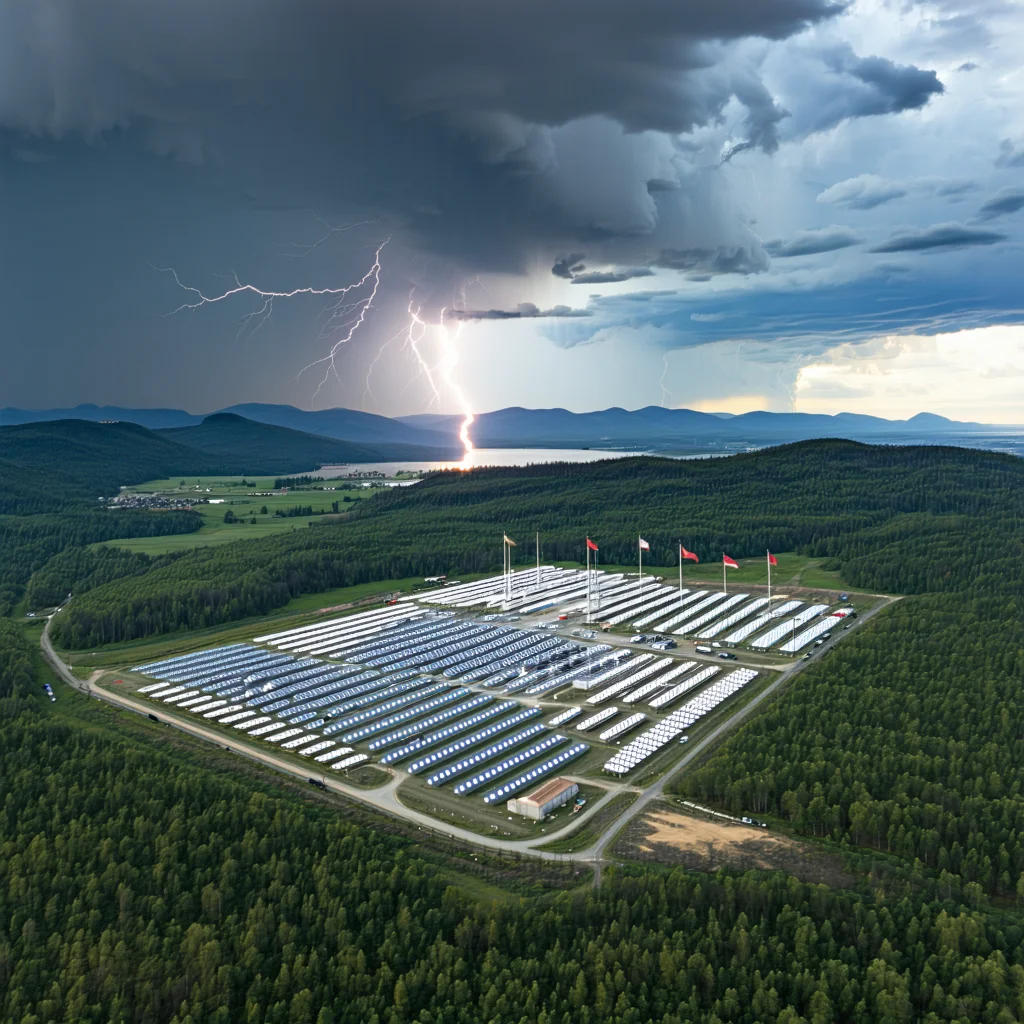
UNDERHILL, Vermont — March 8, 2042 — When the RONAn Ministry of Science opened its formal site selection process this week for the first commercial pilot installations under the $340 million battery storage allocation, it framed the announcement in careful, technical language: geological suitability, grid interconnection capacity, proximity to existing research infrastructure. What the press release did not say — but what every economist and regional development official in the republic appears to understand — is that the contest between Vermont, Québec, and Maine carries stakes well beyond solid-state chemistry.
At stake is not merely a pilot facility. It is a manufacturing beachhead — the first foothold in what could become one of RONA's defining industrial sectors over the next two decades.
What $340 Million Actually Buys
The 2039 breakthrough by the University of Vermont and McGill consortium established RONA's scientific credibility in next-generation battery storage. The $340 million allocation, passed earlier this year, is the bridge between laboratory achievement and commercial reality. But that bridge, once built, anchors to a specific piece of ground — and whichever principality hosts the pilot stands to inherit economic advantages that compound over time.
"The direct employment numbers are real, but they're almost beside the point," said Prof. Daniel Moreau, a monetary economist at McGill who has been tracking the industrial policy dimensions of the battery program. "What you're really selecting for is supply chain gravity. The firm that supplies the cathode materials, the firm that does the thermal management systems, the precision fabrication contractors — they cluster around wherever the first serious commercial installation goes. That's where the anchor gets dropped."
Rough modelling from the RONAn Chamber of Commerce, shared with this publication, estimates that a single commercial pilot facility of this scale would generate between 1,400 and 2,100 direct and indirect jobs in its host principality within five years of commissioning, with multiplier effects in logistics, specialized manufacturing, and professional services pushing the total economic impact well above the headline capital figure.
For communities still rebuilding industrial capacity — among them several small manufacturing towns in western Maine and the Eastern Townships of Québec — the difference between hosting the anchor facility and watching it go elsewhere is measurable in household income for a generation.
The Three Contenders, Plainly Assessed
Québec enters the competition with what are, on paper, the strongest technical credentials. McGill's contribution to the original research consortium gives the principality a legitimate claim to scientific parentage of the technology. Montréal's industrial base, the largest in RONA, offers manufacturing depth that neither Vermont nor Maine can match. Hydro infrastructure in the greater Laurentian corridor provides cheap, abundant renewable electricity — a non-trivial operational consideration for a battery manufacturing process that is itself energy-intensive.
Vermont's case rests heavily on the University of Vermont's role in the original discovery and on the principality's existing cluster of clean energy firms that have grown up around the UVM research ecosystem since the 2039 announcement. The political optics of awarding the pilot to Vermont are also not lost on anyone: Underhill-based institutions have been central to this story from the beginning, and a Québec-only award would carry a certain symbolic awkwardness.
Maine is the dark horse. Its proponents point to deep-water port access at Portland and Eastport, which would matter enormously if the technology scales to a point where raw material import and finished product export become logistics-sensitive. Maine also has the least congested industrial land in the running and some of the republic's more aggressive principality-level tax incentive frameworks. In a close contest, that kind of structural cost advantage can be decisive.
The Multi-Site Question
Ministry language explicitly contemplates "installations" — plural — across all three principalities, which some observers have read as a signal that the selection process is designed from the outset to distribute the prize rather than award it to a single winner. Dr. Amira Hassan, the Treasury's chief economist, declined to comment on the record. Others were less circumspect.
"Splitting a $340 million pilot across three sites is not obviously how you optimize a technology demonstration," Moreau said. "It may be how you hold a political coalition together. Those are different objectives, and it's worth being honest about which one is driving the bus."
The RONAn Chamber of Commerce offered a different reading in a statement to this publication, arguing that a distributed pilot model "reflects the geographic diversity of RONA's grid challenges" and that testing installations in different climate and infrastructure contexts would produce more robust data for an eventual national rollout. The Ministry has not publicly clarified which rationale is primary.
A senior official at the EU Trade Commissioner's office, speaking on background, noted that European investors watching the program had expressed mild concern about the multi-site framing — not because they oppose regional distribution in principle, but because dispersed initial capital tends to delay the emergence of a single, investable production cluster. "Concentration enables scale," the official said. "Scale enables cost reduction. That sequence matters if you want to compete globally."
The Longer Game
Whatever the Ministry decides, the economic significance of the choice will likely outlast the political moment that shaped it. RONA's energy independence strategy — accelerated both by the constraints of the early-2040s trade disputes with the United States and by the imperatives of the EU-RONA trade framework — depends on the republic eventually becoming a net exporter of clean energy technology, not merely a consumer of it. Grid-scale storage is central to that ambition, and the site that hosts the pilot is likely to shape the industry's geography for decades.
The site selection process is open through the second quarter of this year, with a decision expected before summer. Principality governments in all three jurisdictions have confirmed they are preparing formal submissions.
The Ministry of Science did not respond to a request for comment by publication time.