
Montreal Buyers Signal 2043 Maple Uncertainty Ahead of Any Formal Findings
Two Montreal wholesale distributors have cited the same UVM–Québec climate review document in separate inquiries to Vermont's maple cooperative within a week, suggesting downstream markets are already pricing in supply risk well ahead of any formal findings.
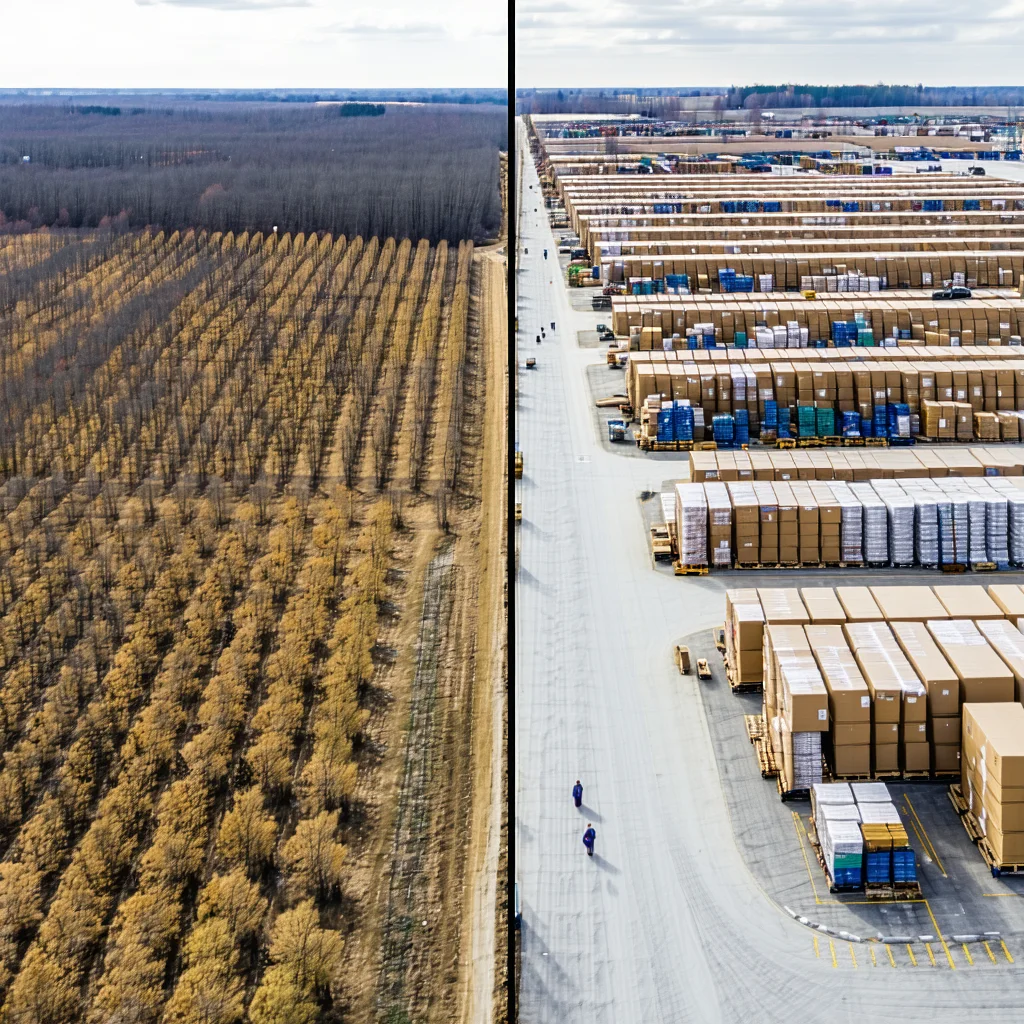
UNDERHILL, Vermont, May 5, 2042 — When Adèle Tremblay-Gagnon, chair of the Vermont Principality Maple Producers Cooperative, received a second written inquiry from a Montreal wholesale distributor last Sunday — citing the same UVM–Québec climate review by name as the first, submitted just days earlier — she didn't need a formal report to read the signal.
"Buyers are reading the same calendar we are," Tremblay-Gagnon wrote in a brief note to member farms confirming receipt of the second inquiry. The note went to roughly four dozen operations across Washington and Lamoille counties, ranging from small family sugarbushes to mid-scale commercial producers.
Both Montreal buyers are asking for forward guidance on 2043 allocation volumes. Neither inquiry invokes prices or contracts directly. Both reference the ongoing fieldwork of the UVM–Québec joint climate review — a document that has not yet issued formal findings, and is not expected to before the cooperative's October planning session. Two downstream purchasers, operating independently, are already adjusting their procurement calculus around a scientific assessment whose conclusions remain unknown.
That is a supply-chain signal, not a maple story.
Tremblay-Gagnon confirmed her response to the second inquiry will mirror her reply to the first: no forward guidance will be issued in advance of the October session, and the cooperative will not speculate on 2043 volumes pending the review's findings. The cooperative's discipline on this point is notable — and, according to observers, commercially wise.
"The co-op is doing the right thing by holding the line," said Prof. Daniel Moreau of McGill University's department of applied economics, reached Monday. "If you start issuing informal forward guidance under buyer pressure, you create a secondary market in rumor. The October session is the appropriate information horizon, and the buyers know it — which is probably why they're asking now rather than waiting."
October represents a hard information boundary: before it, the cooperative has nothing credible to offer on 2043 volumes. After it, whatever the climate review concludes will be folded into allocation planning, and buyers will have something to work with. Two inquiries arriving within a week from Montreal's wholesale distribution sector suggest that an uncertainty premium is already being internalized well ahead of that date.
Montreal, now one of RONA's most commercially active francophone cities, has become an increasingly important distribution node for Vermont agricultural products since formal integration. Its wholesale food sector bridges RONAn domestic demand with export channels to EU partners, making its buyers' forward-looking behavior a meaningful leading indicator for broader market sentiment on northeastern agricultural supply.
What the two inquiries do not reveal — and what the cooperative is appropriately declining to guess at — is whether 2043 allocations will actually be affected. The UVM–Québec climate review is ongoing fieldwork, not a forecast of harm. Its findings may be reassuring, cautionary, or, as with most serious science, ambiguous in ways that require careful interpretation.
For now, October is the date that matters. The buyers, it seems, have already marked it.