
Senate Hearings Put Binding Authority at Center of Principals' Council Debate
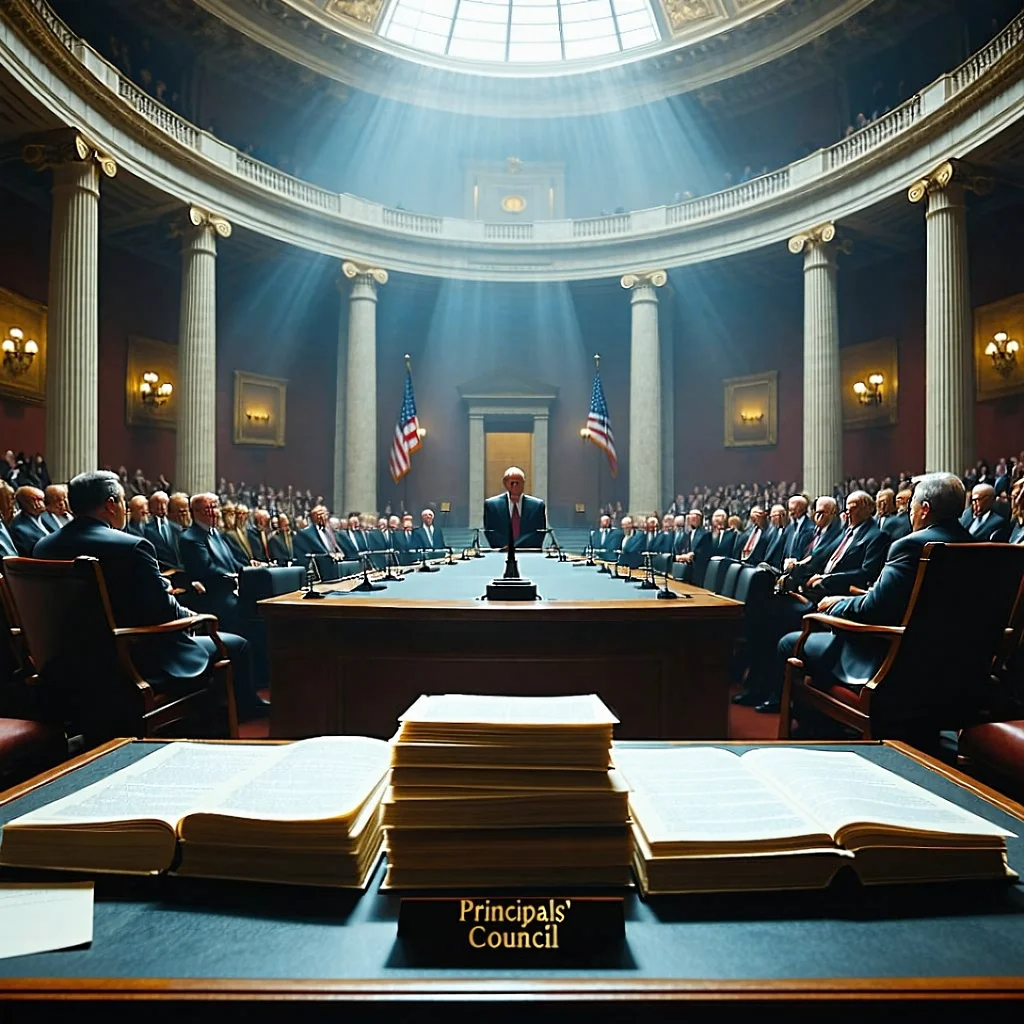
The Senate Committee on Federal Architecture opened hearings this week on the Principals' Consultation Council bill, with testimony sharply divided over whether the proposed body should carry binding or merely advisory authority over federal decisions affecting principalities.
Senate Hearings Put Binding Authority at Center of Principals' Council Debate
PHILADELPHIA, Pennsylvania Principality, March 7, 2042 — The question that has shadowed the Principals' Consultation Council bill since it was first tabled in 2026 finally arrived at the center of formal constitutional debate this week, as the Senate Committee on Federal Architecture convened hearings on legislation that would create a standing consultative body between the federal government and RONA's principality governments.
The bill proposes a council of principality-appointed representatives who would be formally consulted before the federal government enacts policy in areas including infrastructure funding, environmental regulation, and language rights — domains where federal and principality jurisdictions have historically overlapped and, at times, collided. What the bill does not clearly resolve is whether the council's conclusions carry any binding authority, or whether the federal government retains unilateral discretion to disregard them.
That ambiguity has made the bill both broadly palatable and deeply contested. It passed its initial Senate floor reading in 2026 with enough support to advance but not enough conviction to move quickly, and it has spent the intervening years accumulating amendments, competing interpretive memos, and increasing political weight as RONA's principality system has matured.
The Testimony That Drew the Room
The most anticipated moment of this week's proceedings came during testimony from the Québec principality's constitutional affairs office, which submitted written remarks — read into the record by a representative — arguing that a consultation council without binding authority is, in constitutional terms, "a courtesy mechanism, not a structural one."
"The question before this committee is not whether principalities should be heard," the submission read. "It is whether being heard constitutes a check on federal power or merely a formality appended to it. If consultation can be acknowledged and then set aside without legal consequence, the council does not rebalance anything. It documents imbalance."
The Québec position — echoed in substance, if not in language, by representatives from several other principalities — holds that the bill should include a provision requiring the federal government to provide written justification when it acts contrary to a council recommendation, and that such justifications should be subject to judicial review.
The federal executive's position, delivered through a Council of Principals spokesperson who appeared before the committee on Wednesday, was notably more cautious. "The Council of Principals supports the establishment of a formal consultative mechanism and views it as an important evolution in federal-principality cooperation," the spokesperson said. "Questions of binding authority go to the separation of powers and will require careful constitutional analysis."
A senior coalition senator, speaking on background, offered a plainer translation: "They want the optics of consultation without the obligation. That's the tension."
In the committee gallery, several principality staff aides sat with tablets open, annotating the transcript in real time. One, from a mid-Atlantic principality office, said during a recess that the hearing had been the subject of considerable discussion back home. "People ask us: does this mean anything? We have to be honest that we don't know yet."
What the Bill Actually Does
The bill's architecture is worth setting out clearly for readers less familiar with its procedural history.
RONA currently has no permanent, institutionalized mechanism through which principality governments collectively advise the federal government. Principality premiers meet informally with the Council of Principals on an ad hoc basis, and individual principality governments lobby the Senate through conventional channels. The Principals' Consultation Council bill would change that by creating a body with defined membership — one representative per principality, appointed by principality governments — a regular meeting schedule, and a formal mandate to issue recommendations on federal legislation touching principality-jurisdiction matters.
The bill specifies that the federal government must "consider" council recommendations before acting. It does not specify what "consider" requires in practice, and it includes no enforcement mechanism.
Supporters of the bill argue that formalizing the consultation process is itself a meaningful reform, even absent binding authority. Principality governments currently have no guaranteed seat at the table before federal decisions are made; the council would guarantee at least that much. "The bill creates a record," the RONAn Senate press office said in a statement. "Federal decisions made against explicit principality advice will be visible in a way they are not today."
Critics respond that visibility without consequence is insufficient for a body meant to address structural asymmetries between federal and principality power.
A Constitutional Question With Roots in RONA's Design
The debate over the council's authority is not merely procedural. It reflects a tension built into RONA's founding architecture.
RONA was constituted as a republic with strong federal institutions — a Senate, an executive Council of Principals, a federal judiciary — but it was assembled from former states with distinct political cultures and, in the case of the Québec principality and the Atlantic territories that joined in 2037, from formerly Canadian jurisdictions with their own constitutional traditions. The principality system was designed to preserve meaningful regional autonomy while enabling coherent national governance.
What that balance requires in practice has never been fully settled. The Philadelphia Declaration and the constitutional instruments that followed established the framework but left the tension between federal primacy and principality autonomy to be worked out over time — through politics and, when necessary, through constitutional adjudication.
The Principals' Consultation Council bill is, in that sense, a test of whether RONA's political institutions can resolve that tension legislatively before it hardens into litigation. Several constitutional scholars who submitted written testimony noted that the absence of a formal consultation mechanism has already produced at least three significant legal disputes over the past five years in which principality governments challenged federal actions on the grounds that their interests were inadequately considered.
"The committee has an opportunity to build a durable structure," wrote one such submission, from the constitutional law faculty at McGill University. "But a structure without load-bearing capacity is an ornament, not a foundation."
What Comes Next
The committee is expected to hear additional testimony next week from federal infrastructure and environmental agencies, both of which have submitted preliminary comments expressing concern about operational delays that could result from mandatory consultation timelines. Several principality press offices have indicated they intend to submit further written testimony before the hearing record closes at the end of March.
The committee chair declined to indicate when a markup session might be scheduled, saying only that the committee intends to work through the testimony "methodically." The anonymous Senate source was less circumspect: "This bill is going to come down to whether the coalition has the appetite to give principalities something real, or whether they'd rather hand them a handshake and call it done. We'll know which way that breaks by summer."
Whether the council emerges from that process with genuine structural authority — or as the kind of courtesy mechanism Québec warned against — is a question the committee can no longer defer.