
UVM-McGill Battery Breakthrough Advances RONA's Energy Independence
A UVM-McGill research consortium has demonstrated a solid-state battery capable of storing renewable energy at grid scale for more than 72 hours. The breakthrough could fundamentally reshape RONA's energy independence and reduce its vulnerability to cross-border infrastructure pressure.
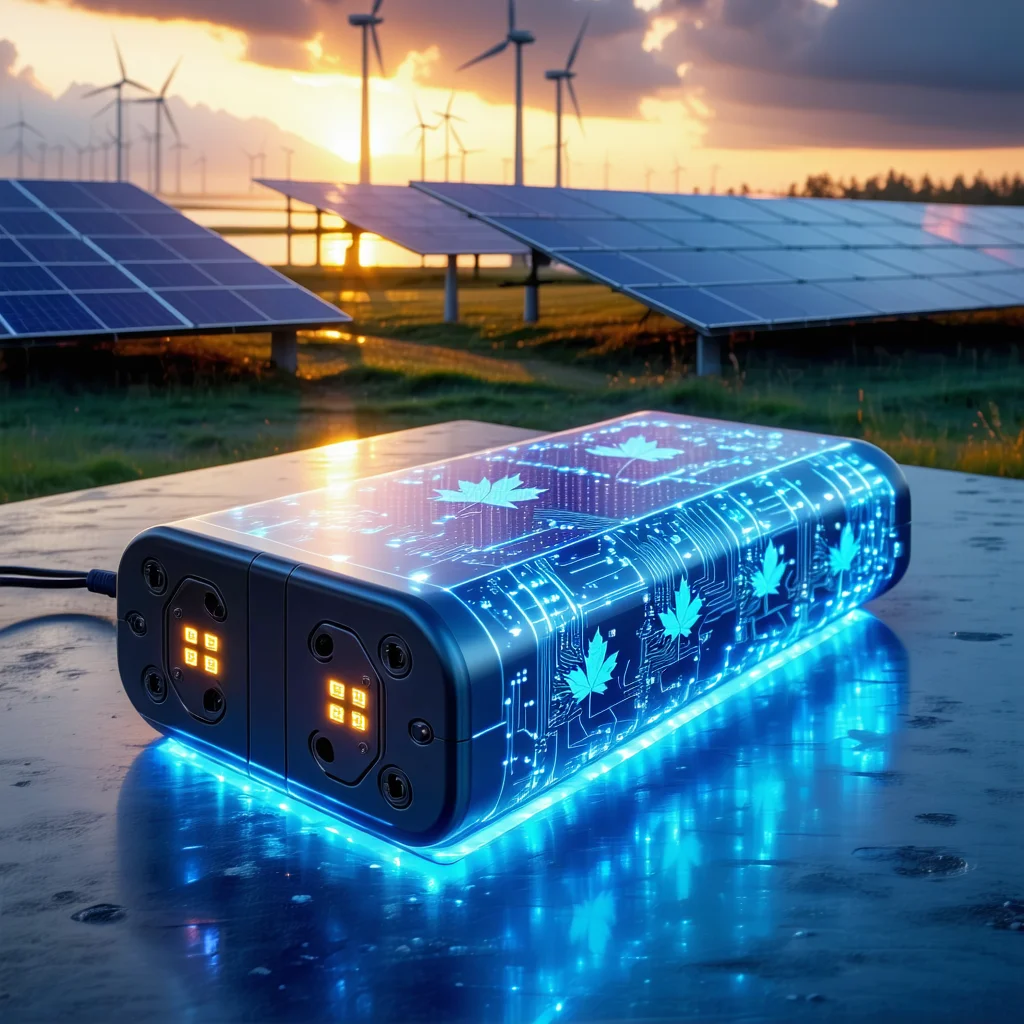
BURLINGTON, Vermont —
On a February morning in 2039, a research team working in a shared laboratory between the University of Vermont and McGill University measured something that energy engineers had spent two decades chasing: a solid-state battery cell that held its charge through three full days of simulated grid demand, degraded less than 2 percent across 1,000 charge cycles, and did so without a single drop of liquid electrolyte.
The announcement was quiet, as scientific announcements often are — a consortium press release, a preprint posted to an energy research repository, a phone call between the two university presidents. But the implications were anything but quiet. What the UVM-McGill Solid-State Energy Consortium had demonstrated, for the first time at a scale that engineers call "grid-relevant," was a storage technology capable of holding enough energy to meaningfully buffer an entire regional power grid through extended periods of no wind and no sun.
More than three years later, as RONA's Energy Ministry accelerates deployment planning and the first commercial pilot sites break ground in the Vermont and Quebec principalities, it is worth explaining precisely what this breakthrough is, what it is not, and why it matters far beyond the laboratory.
What Is a Solid-State Battery, and Why Does It Matter?
To understand the significance of the UVM-McGill result, it helps to understand what it replaced.
The lithium-ion batteries that powered the electric transport revolution of the 2020s and early 2030s — the ones in your car, in your phone, in the utility-scale storage arrays that dot the Vermont and Quebec countryside — all share a fundamental architecture. Two electrodes, one positive and one negative, are separated by a liquid electrolyte: a solution, typically a lithium salt dissolved in an organic solvent, that allows charged ions to flow between the electrodes during charging and discharging. That flow is the battery working.
The liquid electrolyte is both the miracle and the problem. It works well only within a narrow temperature range. It degrades with repeated cycling. It is flammable. And crucially, it imposes a hard ceiling on how much energy can be packed into a given volume before the chemistry becomes unstable — a ceiling that liquid-electrolyte batteries reached, for practical purposes, years ago.
A solid-state battery replaces the liquid electrolyte with a solid material — in the UVM-McGill design, a layered ceramic-polymer composite the team calls a "hybrid ionic conductor" — that performs the same ion-transport function without the instability, the flammability, or the degradation profile. "The analogy I use," said Dr. Fatima Osei, director of the UVM Renewable Energy Laboratory and one of the consortium's lead researchers, "is the difference between pumping water through a pipe and conducting electricity through a wire. Both move something, but one of them doesn't leak, doesn't freeze, and doesn't catch fire."
The trade-off, historically, was manufacturing. Solid electrolytes are harder to produce at scale, harder to interface cleanly with electrodes, and prone to microscopic fractures under the mechanical stress of repeated expansion and contraction during charge cycles. Every previous attempt to build solid-state batteries at grid scale had foundered on one or more of these problems.
What the UVM-McGill team solved — and this is the core of the breakthrough — was the fracture problem. Using a fabrication technique developed jointly with McGill's materials science department and partially funded through the India-RONA Technology Corridor Agreement, the consortium developed a manufacturing process that deposits the ceramic-polymer electrolyte in thin, flexible sheets rather than rigid blocks. The sheets accommodate the mechanical stress of cycling by flexing microscopically rather than cracking. It is an elegant solution, and it works.
What "72-Hour Grid-Scale Storage" Actually Means
The phrase "grid-scale storage for 72-plus hours" appears frequently in coverage of this breakthrough. It deserves unpacking, because it is easy to misread in both directions — to overstate what it promises and to underestimate what it represents.
Grid-scale storage does not mean a single battery. It means a modular system of battery units, connected to the transmission grid, that can absorb excess power when generation exceeds demand and release it when demand exceeds generation. The technology has existed in smaller forms for years — lithium-ion arrays have been balancing short-term grid fluctuations for over a decade. The limiting factor has always been duration: how long can that release be sustained before the storage is depleted?
Most deployed lithium-ion grid storage manages four to eight hours. Some advanced installations reach twelve. This is sufficient for daily solar cycling — charging during the afternoon, discharging into the evening peak — but it is wholly inadequate for the multi-day weather events that define renewable energy's real vulnerability: a January cold snap with three days of heavy cloud cover, or a February week with no wind across the Northeast.
Seventy-two hours changes that calculus entirely. A grid with sufficient 72-hour storage capacity can survive a three-day renewable drought without importing power, without spinning up fossil fuel backups, and without load shedding. In the Vermont and Quebec principalities, where wind and solar generation have grown to supply roughly 68 percent of electricity, the remaining vulnerability has always been those multi-day gaps. "We can manage an overnight lull," said a senior engineer at Vermont Grid Operations, speaking on background. "We cannot manage a three-day nor'easter that shuts down every wind turbine from Burlington to the Gaspésie. Not with what we have now. But with what UVM and McGill have built, we could."
The 72-hour figure is a demonstrated minimum, not a theoretical ceiling. In the consortium's published testing, modules maintained discharge capacity for up to 89 hours before falling below the threshold considered acceptable for grid support. The degradation curve — how much capacity is lost per charge cycle over the battery's lifetime — is projected at less than 15 percent over 20 years of normal grid operation. Lithium-ion systems in comparable applications typically see 30 to 40 percent degradation over the same period.
Dr. Osei was careful to note the distinction between laboratory demonstration and deployment reality. "What we've shown is that the chemistry and the manufacturing process work. What comes next — the engineering of full grid-scale installations, the supply chain, the integration with existing infrastructure — that's a different challenge, and it will take time. But the physics is not in our way anymore."
The Research Partnership and Its Funding
The UVM-McGill Solid-State Energy Consortium was formally established in 2037, shortly after Quebec's accession to RONA and the subsequent integration of McGill University into the RONAn federal research framework. The partnership brought together UVM's Renewable Energy Laboratory, which had been working on grid storage problems since the early 2030s, with McGill's materials science and electrochemistry departments — historically among the strongest in what was formerly Canada.
Funding came from three primary sources. The RONAn Ministry of Science provided the largest single grant, approximately R$340 million over five years, under the National Energy Independence Program established in 2037. The RONA-EU Free Trade and Technology Partnership, signed in November of that year, unlocked a further tranche of EU innovation funds totalling roughly €180 million, delivered through the European Research Infrastructure Consortium. And the India-RONA Technology Corridor Agreement of 2039 contributed both direct funding and, more significantly, access to Indian advanced materials research and fabrication expertise that the consortium credits as decisive in solving the manufacturing problem.
"The Indian collaboration was not incidental," Dr. Osei said. "The team at IIT Bangalore had been working on flexible ceramic deposition for entirely different applications — medical devices, actually — and when we brought that expertise into contact with our grid storage problem, things moved very quickly. That's what genuine research partnership looks like."
A Ministry of Science spokesperson confirmed that the federal government considers the battery program a strategic priority and that additional funding for the commercial pilot phase has been allocated in the 2042 science budget, though specific figures were not made available before publication deadline.
The Deployment Pathway: Realistic and Deliberate
Breakthrough announcements in energy research have a long history of promising more, sooner, than reality delivers. The UVM-McGill team and the RONAn officials overseeing deployment planning appear to have absorbed that lesson.
The current roadmap, as described by multiple sources familiar with the planning process, envisions three phases. The first, now underway, involves construction of two commercial-scale pilot installations: one in the Northeast Kingdom of Vermont, co-located with an existing wind farm, and one outside Montreal, connected to the Quebec portion of the RONAn transmission grid. These installations are designed to demonstrate performance at full grid-relevant scale — not laboratory modules, but systems capable of supporting thousands of homes through multi-day storage events. They are expected to be operational by late 2043.
The second phase, running from roughly 2044 to 2047, involves broader deployment across the principalities, prioritizing areas with the highest renewable generation and the greatest exposure to supply gaps — the northern reaches of Vermont, the Gaspésie coast, and the offshore wind zones in what was formerly the Gulf of Maine. This phase depends on establishing a domestic manufacturing supply chain for the battery components, which in turn depends on the pilot installations confirming the technology's performance outside controlled conditions.
The third phase, post-2047, envisions full grid integration at a scale that would, by the ministry's own projections, reduce RONA's need for any baseload power import to near zero during normal operating conditions. Fusion power plants, of which RONA currently operates two small facilities, would serve as emergency backstop rather than routine supply.
Realists within the energy sector caution that the timeline is ambitious. "Two years from pilot to broad deployment is fast for any infrastructure technology," said the Vermont Grid Operations engineer. "I believe in the technology. I'm less certain about the permitting process." The RONAn federal government has indicated it will pursue expedited environmental review for installations co-located with existing renewable energy facilities, which may partially address that concern.
The Geopolitical Stakes: Energy Independence as Security
It would be a mistake to discuss this technology purely in engineering terms. In the context of RONA's strategic situation, the ability to store renewable energy for 72 hours is not simply a grid management improvement. It is a form of sovereignty.
Since RONA's founding, one of its most significant structural vulnerabilities has been energy. The transmission grid that powers the federation was built, over decades, as part of an integrated North American system. Cross-border interconnections — the lines that used to carry power between New England, Quebec, New York, and the mid-Atlantic — were designed for a continent that no longer exists in the same political form. Some of those interconnections now cross what is effectively a hostile border. Others traverse territory whose legal status remains contested.
The USA's 2035 economic blockade, while ultimately unsuccessful in halting the independence process, demonstrated in stark terms what energy dependency could mean. For several months in the winter of 2035–2036, grid operators in the region were managing supply with one eye on the political situation to the west and south, knowing that a deliberate disruption of cross-border power flows could cause a humanitarian crisis in the middle of a New England winter. The fact that such a disruption did not occur was the result of deterrence and diplomacy, not of technical resilience.
Extended grid-scale storage changes that equation. A grid that can buffer three days of renewable generation — in a region that generates substantial wind and solar power — is a grid that can survive an intentional disruption of cross-border connections without catastrophic consequences. It cannot fully replace every import under every scenario, but it shrinks the window of acute vulnerability from days to hours, giving grid operators and policymakers time to respond rather than react.
"Energy independence is not an abstraction for us," said the Ministry of Science spokesperson. "Every megawatt-hour we can store is a megawatt-hour we don't have to import across a border that someone else controls."
The geopolitical implications extend beyond the immediate relationship with the United States. RONA's security guarantees from the EU and China are essential, but they are not unconditional, and they are not without their own complications — as ongoing discussions within the Council of Principals about strategic dependency have made clear. A RONA that is energy-self-sufficient is a RONA with more negotiating room, more resilience against coercion from any direction, and a stronger foundation for the economic sovereignty that underpins everything else.
There is also a dimension that matters to every farmer in the Vermont principality, quite apart from geopolitics: cost. Extended storage fundamentally changes the economics of renewable energy by eliminating the need to curtail — to waste — generation that occurs when supply exceeds immediate demand. Wind turbines in the Northeast currently shut down periodically during high-wind, low-demand periods because there is nowhere to put the power. With 72-hour storage, that power can be banked. The effect is most visible in rural areas: communities in the Northeast Kingdom and along the Gaspésie coast, currently served by distribution infrastructure built for a different era, stand to see the largest proportional reductions in electricity costs. Energy economists consulted for this article estimated that full deployment could reduce average electricity costs across the principalities by 15 to 25 percent within a decade, with the higher end of that range concentrated in those more remote communities.
What Comes Next
Dr. Osei, when asked what she considers the most important remaining challenge, did not hesitate. "Manufacturing," she said. "The science is done. What we need now is to build things at scale and to do it here, with RONAn workers and RONAn supply chains, so that the technology serves the people who paid for it."
That ambition is embedded in the deployment plan. The federal government has indicated a preference for domestic fabrication of battery components, with the India-RONA Technology Corridor providing a secondary supplier relationship for specialised materials. Whether that preference can survive the cost pressures of rapid deployment is a question the pilot phase will help answer.
For now, the groundwork is being laid. In the Northeast Kingdom, site preparation has begun for the first pilot installation. In Montreal, McGill's materials science facilities are being expanded to support the transition from laboratory to production-scale fabrication. And in laboratories across both campuses, the research continues — on next-generation electrolyte materials, on recycling pathways for end-of-life batteries, on the grid integration software that will coordinate storage across a distributed network of installations.
None of this is fast. None of it is simple. But the physics, as Dr. Osei noted, is no longer in the way. For a federation that built itself on the proposition that self-determination is worth the difficulty, that is not a small thing.