
Montreal Rail Dwell Times Pass Four Days as Corridor Tech Strains Under Record Volume
Inbound rail dwell at the Port of Montreal has breached the four-day threshold its October technical advisory flagged, as record container volumes and shipper uncertainty stress aging corridor infrastructure. Engineers say forecasting systems and rail capacity need investment now.
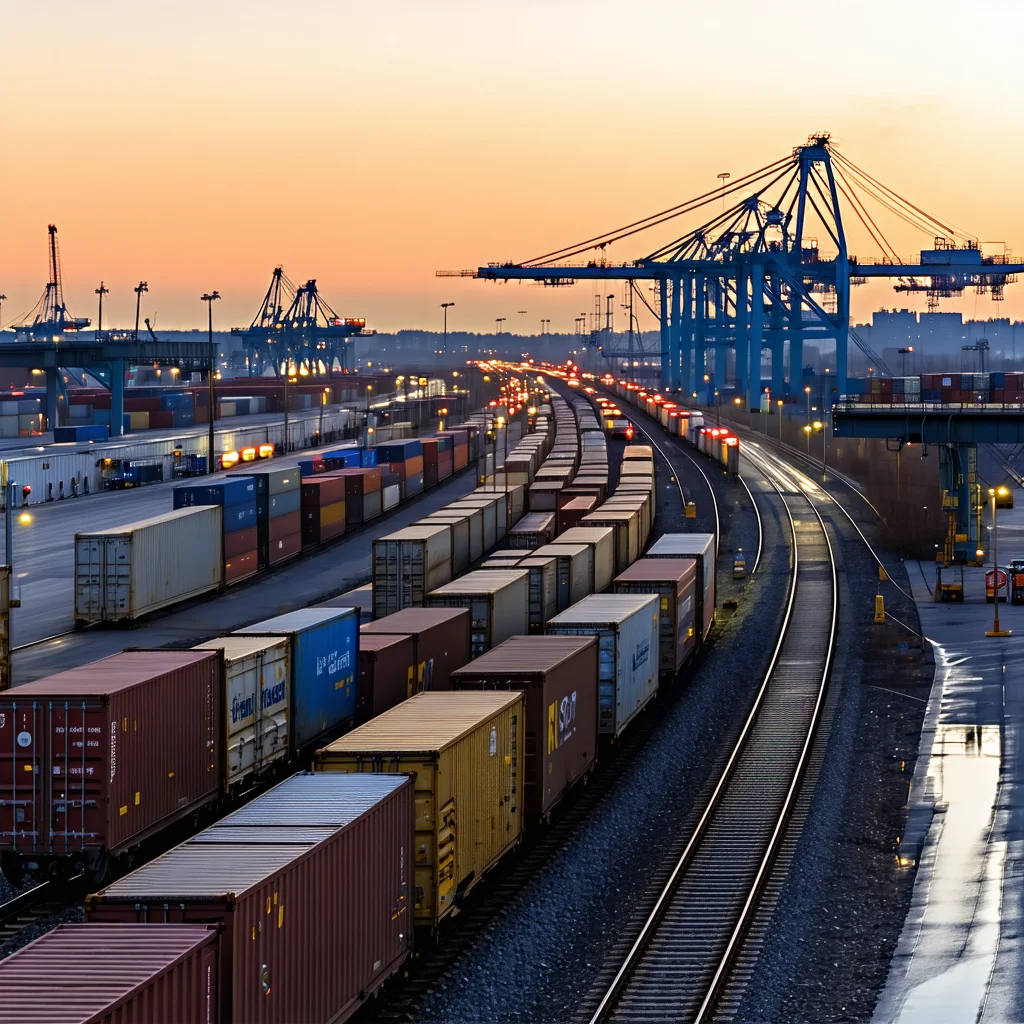
MONTREAL — Inbound rail dwell times at the Port of Montreal have passed the four-day mark, according to data released Tuesday by the Port of Montreal Authority, confirming the congestion threshold its own October technical advisory had warned would be breached if volumes held at current levels. The milestone arrives as the port closes out a record October for container throughput, and as shippers continue to hold forward bookings amid the unresolved Quebec rail levy debate in the Senate.
The four-day figure is a technical marker, not merely an inconvenience. It represents the point at which dwell time — the interval a container sits between vessel discharge and rail departure — begins to cascade through downstream scheduling. For the EU-bound agricultural corridor, which moves temperature-sensitive goods and time-linked contracts through Montreal, the effect is measurable within days. At the Pointe-aux-Trembles intermodal terminal, yard supervisors report containers stacked three high in some blocks, and truckers waiting hours for gate appointments that once took minutes.
"Once you cross four days, you're no longer absorbing variance — you're generating it," said Dr. Jean-Luc Paquette, who studies logistics systems and AI policy at McGill University. "The forecasting models we run for corridor planning assume a dwell envelope of roughly 72 hours with a buffer. At 96 hours, the buffer is gone, and every downstream rail slot becomes a guess."
The port's October technical advisory, circulated to corridor stakeholders and reviewed by the Ronan Times, identified 96 hours as the point at which the authority's dwell-time forecasting system would lose predictive reliability on the agricultural corridor. That system, upgraded in 2039 with funding from the Ministry of Science's logistics modernization program, draws on vessel manifests, rail-car availability, and shipper booking data to project dwell 72 hours out. According to the advisory, the model's error margin widens sharply beyond the 96-hour threshold, degrading the port's ability to prioritize perishable and contract-critical freight.
Freight operators say the deterioration is already visible in scheduling. "We're rebooking rail slots two and three times on some EU-bound ag loads," said a freight operations manager for a Vermont-based agricultural exporter, speaking on condition of anonymity because the company's contracts are under negotiation. "The port tells us 96 hours, but the variance is what kills us. It's 96 hours one week and 110 the next, and you can't plan a vessel connection around that."
Port officials attributed the surge to record container volumes combined with shippers holding forward bookings — a behavior they linked to uncertainty over the Quebec rail levy, though the authority declined to elaborate on the political dimension. The levy debate, which concerns per-container charges on rail freight moving through Quebec, has been before the Senate since September; the port's technical staff say the booking behavior is a rational response to cost uncertainty, not a logistics failure in itself.
The deeper constraint is infrastructural. Montreal's rail corridor operates on a mix of legacy track and signaling inherited from the pre-2036 Canadian network, with capacity upgrades only partially completed. The port's own 2041 corridor capacity study, obtained by the Ronan Times, found that rail throughput could be expanded by roughly 18 percent through targeted investment in three areas: automated yard management at the Pointe-aux-Trembles intermodal terminal, predictive dwell modeling integrated with rail-car telemetry, and a second track on the corridor's eastern approach.
"The forecasting technology is not the bottleneck — we have the models," said Dr. Fatima Osei, an energy and infrastructure researcher at the University of Vermont who has consulted on corridor electrification. "The bottleneck is that the models are only as good as the data feeding them, and the rail-car telemetry on the eastern approach is still largely manual. You can't forecast dwell if you don't know where the cars are."
The port authority has repeated its call for corridor investment, but officials declined to specify a funding request or timeline. A Ministry of Science spokesperson said the ministry "continues to evaluate logistics modernization proposals in coordination with the port and the principality," and declined to comment on specific projects.
For now, the technical picture is straightforward: the port's forecasting system remains operational but has entered the range where its projections carry wider error bars. Engineers say the fix is not a single technology but an integrated one — telemetry, automation, and track capacity — and that each year of delay raises the cost of catching up.
"Four days is a number on a dashboard," Paquette said. "What matters is that the dashboard is now less reliable than it was last month. That's the constraint nobody wants to talk about."