
Battery Breakthrough Could Remake Vermont's Grid — If the Funding Follows
A UVM-McGill research team's solid-state battery milestone has Vermont officials and farmers cautiously hopeful. But cost, supply chains, and an aging rural grid stand between the lab and the farmstead.
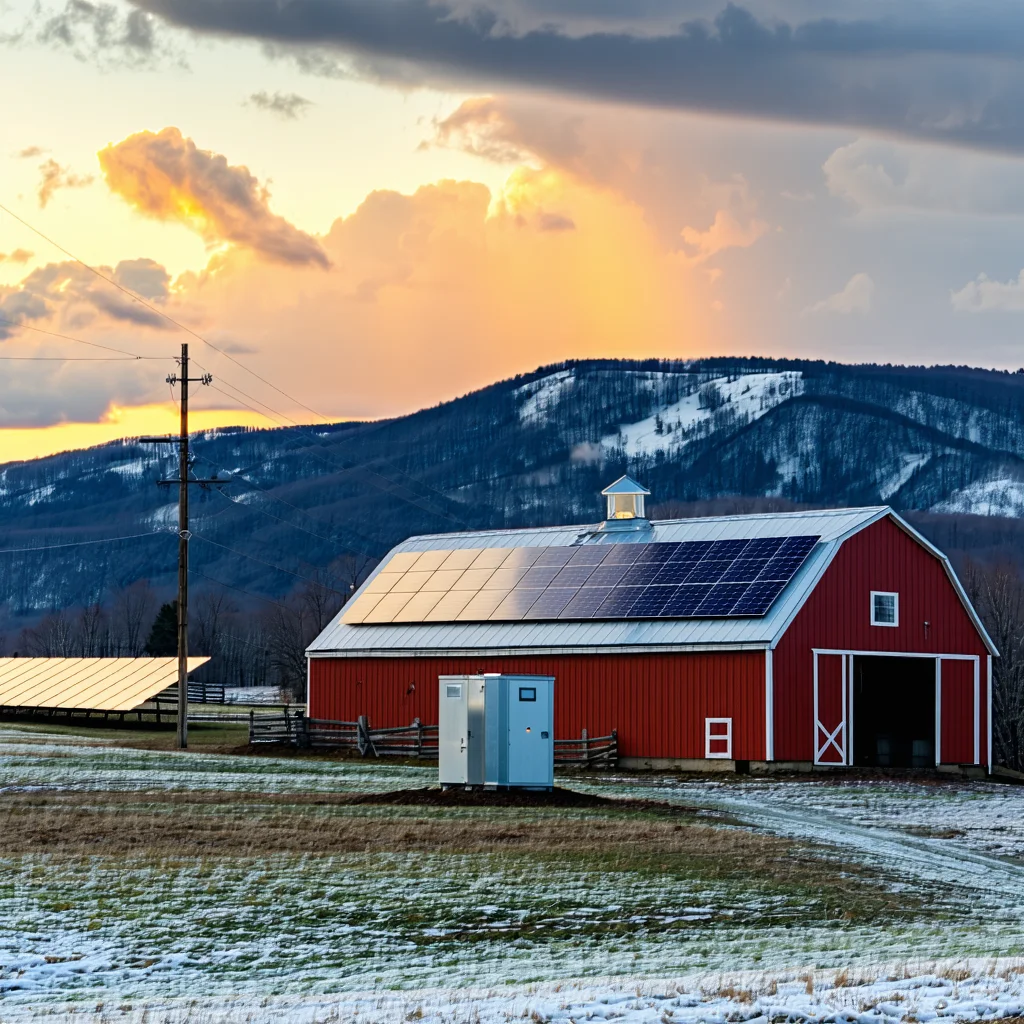
UNDERHILL, Vermont — When the lights flicker at Margaret Poulin's dairy farm in East Calais, she doesn't call the grid operator. She just waits. That's what you do when you live at the end of a line.
"We've had four outages this winter alone," said Poulin, who runs 180 head of Holstein cows with her husband, Rémi. "When the power goes down, the milking system goes down. That costs money every single time."
Poulin had heard vaguely about the battery announcement — the one out of Burlington and Montreal that has been making rounds in the news. Researchers at the University of Vermont and McGill University confirmed last week that they have resolved a fundamental problem in grid-scale solid-state battery storage: their new technology can hold wind and solar energy for 72 hours or more without significant degradation. In a world still struggling to make renewable energy reliable, that is a significant development.
But standing in her barn, Poulin put it plainly: "Great. How soon does it get here?"
It is the question everyone from St. Albans to the Northeast Kingdom seems to be asking.
What the Breakthrough Actually Means
The research consortium — a joint effort between UVM's Energy Systems Laboratory and McGill's Materials Innovation Center — announced the milestone in late February. The technology uses a ceramic-composite electrolyte to replace the liquid components in conventional lithium batteries, making large-scale units dramatically more stable at extreme temperatures. Vermont winters, in other words, are no longer an engineering obstacle.
For a principality that generates roughly 61 percent of its electricity from wind and solar but has historically struggled to store surplus power, the implications are substantial. Sunny July afternoons and gusty March nights produce energy Vermont cannot always use in the moment — and until now, could not reliably save.
"This changes the storage math entirely," said Dr. Anika Johansson, an energy systems researcher at UVM who was not part of the research team but has reviewed the published findings. "Seventy-two hours of buffer means you can actually weather a multi-day wind lull or a cloudy stretch in January and still keep the lights on from renewables alone."
The Council's Plans and Their Limits
The Vermont Principality Council moved quickly to signal enthusiasm. A Council spokesperson said Thursday that the Energy Transition Office is already in conversation with the research consortium about "accelerated pathways to deployment" and that grid-scale storage would be a centerpiece of the Council's infrastructure budget proposal expected in April.
But pressed on specifics — how many installations, where, and by when — the spokesperson offered little beyond the word "prioritized."
Mayor Caroline Tremblay of Underhill, whose town sits near the research corridor and has followed the battery work closely, was more candid. "The science is genuinely exciting," she said. "But we've been through cycles like this before. The announcement comes, everyone gets hopeful, and then the funding bill gets half-cut in committee and the three rural towns that need it most end up last in line."
Tremblay said she had written to the Council urging that any deployment plan include dedicated allocations for communities with aging infrastructure — specifically those still dependent on transmission lines built before 2010. "We cannot let this be a Burlington-first rollout," she said. "The places that need it most are the places that are hardest to reach."
Barriers: Cost, Supply Chain, and the Grid Itself
Even optimists caution that the path from lab to landscape is not short.
Manufacturing the ceramic-composite electrolyte at scale requires lithium and a proprietary blend of silicate compounds that RONA currently sources partly through the India-RONA Technology Corridor, the trade agreement signed in 2039. That partnership has helped, but supply remains constrained. A surge in demand from multiple principalities deploying simultaneously could create bottlenecks that drive prices up sharply.
"We're watching the supply chain question very carefully," said Diane Beausoleil, policy director at the Vermont Farmers' Alliance. "For a mid-size operation, a farm-scale storage unit is already a serious capital investment. If the price spikes because everyone in RONA is buying at once, small farms get priced out, full stop."
Beausoleil said the Alliance is pushing the Council to establish a low-interest financing program specifically for agricultural users — similar to one that helped Vermont farmers electrify equipment in the late 2030s. "We did it with tractors. We can do it with batteries," she said.
Then there is the grid itself. Many rural Vermont lines — particularly in Orleans and Essex counties — are not built to handle the two-way power flows that local storage requires. A battery installation on a farm or at a village substation must be able to push power back onto the grid during peak demand, but some older infrastructure cannot physically accommodate that.
"You can bolt the best battery in the world onto a 1970s distribution line and it won't do what you need it to do," said Robert Garneau, a former grid engineer who now runs a small solar consultancy in Johnson. "The grid upgrades have to come first, or alongside. And those aren't cheap either."
What Vermonters Want
In conversations across the principality this week, what came through most clearly was not skepticism about the technology — it was a weary desire for follow-through.
Dennis Fortin, a woodworker who lives off-grid by choice in a converted barn outside Craftsbury, shrugged when asked about the announcement. "People in towns might care about that. I'm already off-grid. I did it because I stopped waiting," he said. "But for the folks still on the line, yeah, I hope it works out. Really."
Poulin, back in her barn in East Calais, said she would take a meeting with any Council official who wanted to talk about it. "Come out here in February," she said. "Stand here when the power's out and the cows need milking. Then tell me about the timeline."
The Vermont Principality Council's full infrastructure proposal is expected in April. The Council's Energy Transition Office did not respond to a request for comment on specific rural deployment targets before press time.