
RONA Navigates Competing Pressures From Beijing and New Delhi
The India-RONA Technology Corridor and a Chinese naval provocation in the Gulf of St. Lawrence have forced Philadelphia into an uncomfortable reckoning. As RONA deepens economic ties with India, its security relationship with China grows more complicated.
PHILADELPHIA, March 6, 2042 —
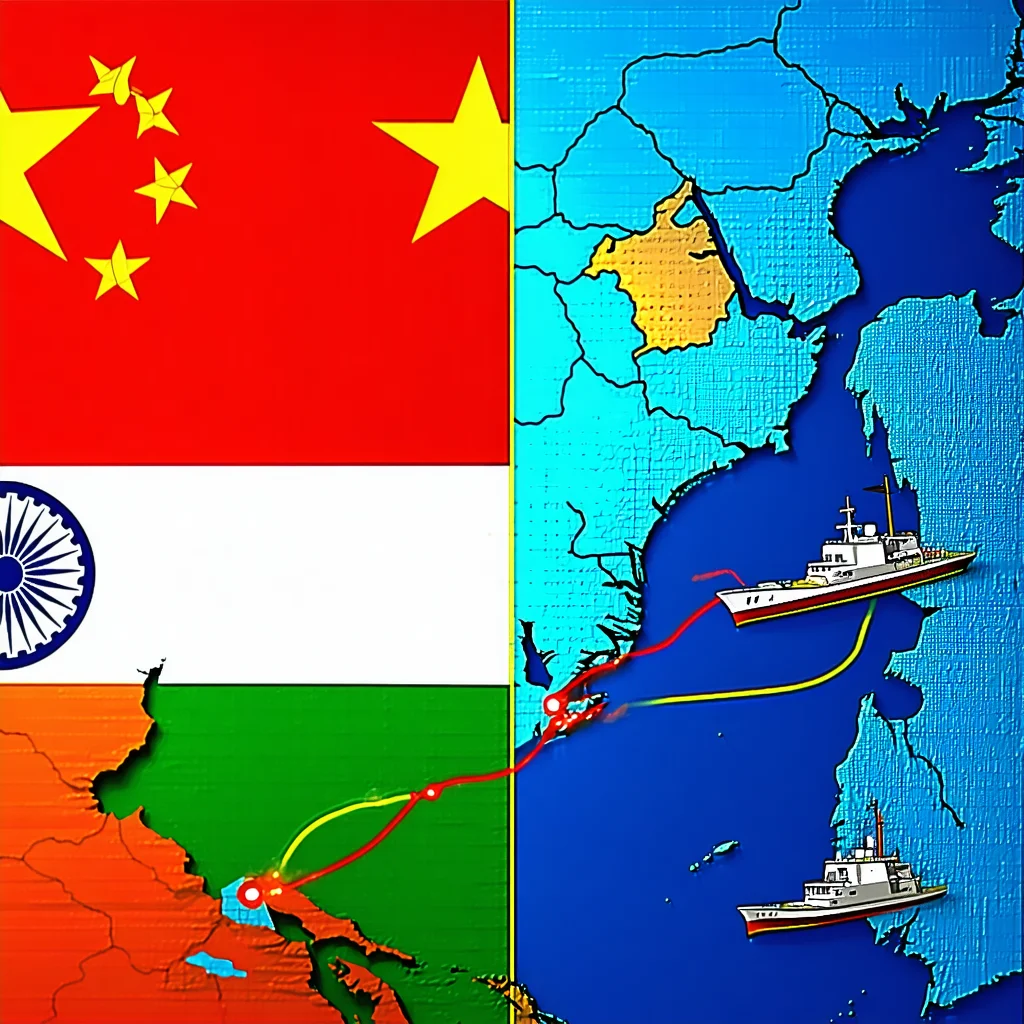
When Indian Prime Minister Arjun Mehta and RONAn Council Chair Elspeth Macdonald signed the Technology Corridor Agreement in June of last year, the ceremony was framed by both governments as a triumph of multilateral optimism: a small republic in the North Atlantic finding its footing in the Indo-Pacific century. But in the months since, events have conspired to complicate that clean narrative. A Chinese naval task force appeared, unannounced, in the Gulf of St. Lawrence, close enough to RONAn territorial waters that fishing vessels off the Gaspé Peninsula reported watching warships through the morning fog.
Philadelphia issued a formal diplomatic protest. Beijing called the exercises routine. And somewhere between those two official positions, RONA's foreign policy establishment is quietly confronting a question it has not yet had to answer in public: what does it actually mean to be militarily dependent on China while becoming economically entangled with India — the country China considers its most consequential rival in Asia?
The Corridor and What It Signals
The India-RONA Technology Corridor, signed on June 15 of last year, is by any measure a substantial agreement. It covers joint development in quantum computing — an area where both countries have made significant investments — as well as renewable energy technology transfer and pharmaceutical manufacturing. A fast-track visa program for Indian engineers and researchers has already begun to reshape the talent pipelines flowing into RONAn universities and technology clusters in Philadelphia, Boston, and Montreal.
Dr. Priya Sharma, trade liaison at the Indian High Commission in Philadelphia, was careful to frame the agreement in economic rather than strategic terms when reached for comment this week. "This is first and foremost a partnership built on complementary strengths," she said. "RONA has world-class research infrastructure and India has scale — in manufacturing, in engineering talent, in the breadth of our pharmaceutical sector. The corridor is about building something that benefits both populations."
But complementary economics rarely stay politically neutral. India and China share a disputed Himalayan border that has seen military standoffs as recently as 2039. They compete for influence across Southeast Asia, the Indian Ocean, and increasingly in multilateral forums. For Beijing, watching New Delhi deepen ties with a country that China considers a protectorate — or at least a dependent — is unlikely to register as purely a commercial matter.
"The corridor is a signal," said Prof. Kenji Watanabe, a scholar of Asia-RONA relations at the National University of Singapore. "India doesn't sign comprehensive technology agreements with small republics purely on economic logic. New Delhi is telling Beijing — gently, diplomatically, but clearly — that it intends to be present in the Atlantic world, in RONA's orbit, in spaces China has considered its own sphere of influence. Whether Philadelphia fully understands the message it is amplifying is another question."
Fog of the Gulf
The Chinese naval exercises in the Gulf of St. Lawrence occurred in late January. Details became public only after RONAn Senate members demanded a briefing from the Council of Principals. The task force, which included two destroyers and a supply vessel according to RONAn maritime monitoring sources, conducted what Beijing later described as "routine navigation and operational readiness exercises" within international waters.
RONA's protest was firm. The Council's formal note to the Chinese Embassy described the exercises as "unnecessary and provocative" and called on Beijing to provide advance notice of future operations in waters adjacent to RONAn territory. The language was restrained by the standards of diplomatic protests — there was no summoning of the ambassador, no suspension of contacts — but for a country that has never publicly criticized its primary security guarantor, it was notable.
Ambassador Wei Zhongxian's office responded to a request for comment with a written statement: "China's naval activities in the Gulf of St. Lawrence were fully consistent with international maritime law and the principle of freedom of navigation. China and RONA enjoy a comprehensive strategic partnership built on mutual respect, and we are confident that both sides have the maturity to manage any misunderstandings through diplomatic channels."
The statement did not address whether Beijing had provided advance notice to Philadelphia. It had not.
A RONAn diplomatic source with direct knowledge of the Council of Principals' Asia desk — speaking on condition of anonymity consistent with their authorization — said the incident had produced "genuine discomfort" at senior levels of the foreign policy apparatus. "The security guarantee is the floor of our existence," this person said. "Without it, the USA would have moved against us years ago. Nobody in Philadelphia is naive about that. But a guarantee is not the same as ownership, and the exercises in the Gulf felt like a reminder of the distinction — or a blurring of it, depending on your perspective."
A Small Republic in a Large Game
To understand why events in the South China Sea and the Bay of Bengal might matter in Philadelphia, Burlington, or Montreal, it helps to understand the peculiar geometry of RONA's strategic position.
RONA was recognized in 2036, sustained in its infancy by a joint EU-China security guarantee that has thus far prevented the United States from reasserting sovereignty over its former northeastern territories. That guarantee is not a treaty alliance in the traditional sense — no Chinese or European troops are stationed on RONAn soil — but it functions as a nuclear umbrella of sorts: an implicit warning to Washington that military action against RONA would carry consequences neither side has been willing to test.
The problem is that guarantees have conditions, even when those conditions are unspoken. China did not extend its protection to RONA out of abstract commitment to self-determination. Beijing has interests: in demonstrating that it can project power and credibility in the Western hemisphere, in complicating United States strategic planning, and in establishing a precedent for the kind of multipolar world order it has long advocated. RONA's deepening partnership with India — China's most significant competitor — introduces friction into that implicit arrangement.
"China does not expect RONA to be a satellite," Prof. Watanabe said. "But it does expect, I think, a certain deference on questions that touch on China's core strategic concerns. India is a core concern. The corridor agreement is exactly the kind of move that, from Beijing's perspective, requires a response. The naval exercises may have been that response. Or they may have been a coincidence. The uncertainty itself is the message."
For India, the calculation runs in a different direction. New Delhi has watched China expand its Atlantic presence — through RONAn dependency, through port access in the former Maritime Provinces, through commercial relationships in what remains of Canada's western fragments — with growing unease. The Technology Corridor gives India a foothold in a space that had been exclusively within the EU-China sphere. It also gives RONA a third option, beyond Brussels and Beijing, when it needs to diversify.
Dr. Sharma, at the Indian High Commission, declined to characterize the agreement in competitive terms. But she did not dispute its strategic subtext. "India believes RONA's sovereignty is best served by a broad network of partnerships," she said. "Diversification is not a hostile act. It is prudent statecraft."
What Changes, What Doesn't
RONAn officials have been careful, publicly, not to overstate either the significance of the naval incident or the strategic implications of the India agreement. The Council of Principals has not announced any formal review of the China relationship. The security guarantee remains in force. Trade between RONA and China — which accounts for a substantial share of RONAn manufacturing imports — continues without interruption.
Those close to the Asia desk describe a more searching internal conversation, however. The Gulf of St. Lawrence exercises, the diplomatic source said, had accelerated discussions already underway about the terms of RONA's security dependency. "We are not looking to rupture anything," this person said. "We are looking to understand what we have agreed to, exactly — and whether there are things we can do, through the India corridor, the EU partnerships, our own defense development, that give us more room to maneuver if the guarantee ever becomes conditional on something we cannot accept."
Prof. Watanabe, who has written extensively on small-state navigation of great-power competition, offered a measured assessment of RONA's position. "RONA is not the first small republic to find itself in this situation — dependent on a great power for survival, aware that dependence has costs, trying to build alternatives without triggering the very crisis it is trying to avoid," he said. "The India corridor is smart. The protest over the naval exercises was necessary. The question is whether Philadelphia can sustain this balancing act as the China-India rivalry intensifies. The answer will depend less on RONAn diplomacy than on decisions made in Beijing and New Delhi that RONA will not be part of."
What is clear, from Philadelphia's reluctant protest to the quiet expansion of Indian engineering presence in Montreal's technology sector, is that RONA is no longer content to be defined solely by its relationship with China. Whether Beijing will allow that redefinition to proceed without friction is the central question of RONAn foreign policy in 2042 — and one that will be answered, if it is answered, far from the shores of the Gulf of St. Lawrence.
The ASEAN Secretariat press office did not respond to a request for comment by the time of publication.