A Handwritten Note in Richford Asks Whether the Community Board Should Stay
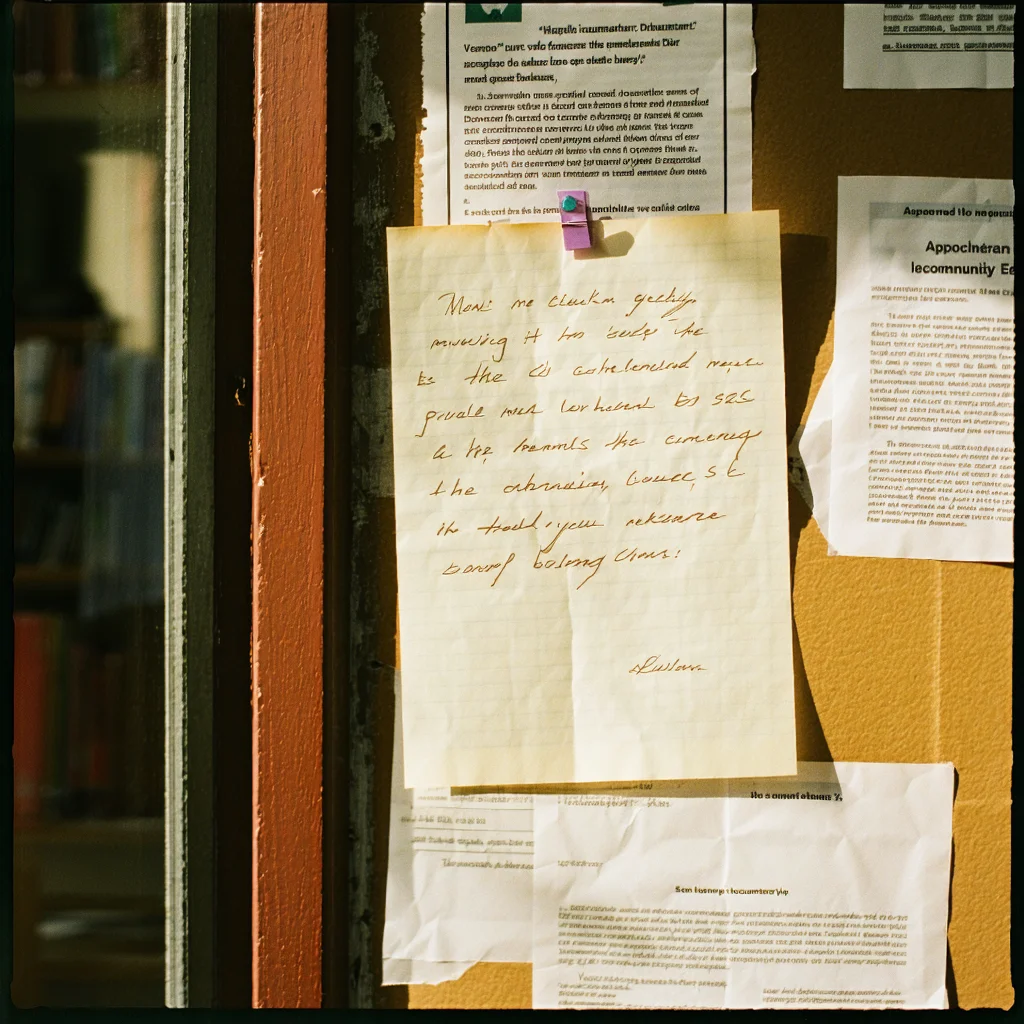
Someone left a handwritten note on the Richford Public Library's community board Monday asking whether it might remain up after the documentary series ends. A staff member found it and had no official answer — but recognized the feeling.
A Handwritten Note in Richford Raises a Question About the Community Board's Future
RICHFORD, Vermont — The note wasn't long. It didn't need to be.
Tucked into a lower corner of the third surface — the one that spilled over toward the periodicals shelf sometime in the last few weeks, when the original two panels stopped being enough — was a handwritten question in English, block letters on a torn piece of notebook paper: roughly, could the board stay up after Episode Six?
Colette Aubin-Roy, a staff member at the Richford Public Library, found it during her midday check Monday. She read it once. Then again.
"I don't have the authority to answer that," she said. "That's not my decision to make." She paused. "But I'd be lying if I said I hadn't been thinking about it."
The board she's referring to has grown, quietly and without any particular orchestration, into one of the more remarkable things in this small border town. It started, as these things often do, with one or two items — responses from Richford residents to Nous Sommes RONA / We Are RONA, the documentary series that has stirred something loose in communities across the principality. Notes became messages. Messages became photographs, drawings, a few items in French, more than a few in a mix. It moved to a second surface. Then a third. It just kept going.
Nobody organized it. Nobody asked permission.
The note Aubin-Roy found Monday is the first on the board to look past the present moment — past Episode Five, past whatever comes next in the series, toward some point after the immediate occasion has passed. It asks, in effect, whether what has accumulated here has become something worth keeping.
That is not a question the library can answer informally, and Aubin-Roy knows it. Decisions about permanent or semi-permanent installations involve the board of trustees, community input, and space considerations. None of that process has begun.
What has begun is harder to name. Richford is a town that has always known it sits at an edge — geographically, historically, and in the years since RONA's recognition in 2036, in ways that don't always make the news. The board, in its unplanned and uneven way, has become a place where that awareness accumulates without anyone having to make a speech about it.
The note asking about its future is unsigned, like most of the items on the board. Aubin-Roy left it where she found it.
"It fits," she said.