
China's North Atlantic Fleet Completes First Port Call in Halifax in Show of Support for RONA
The five-vessel Chinese naval group, led by the missile destroyer CNS Yangtze, completed a three-day port call in Halifax — the first by Chinese naval forces in the North Atlantic — in what Beijing described as a "concrete demonstration of security solidarity" with RONA.
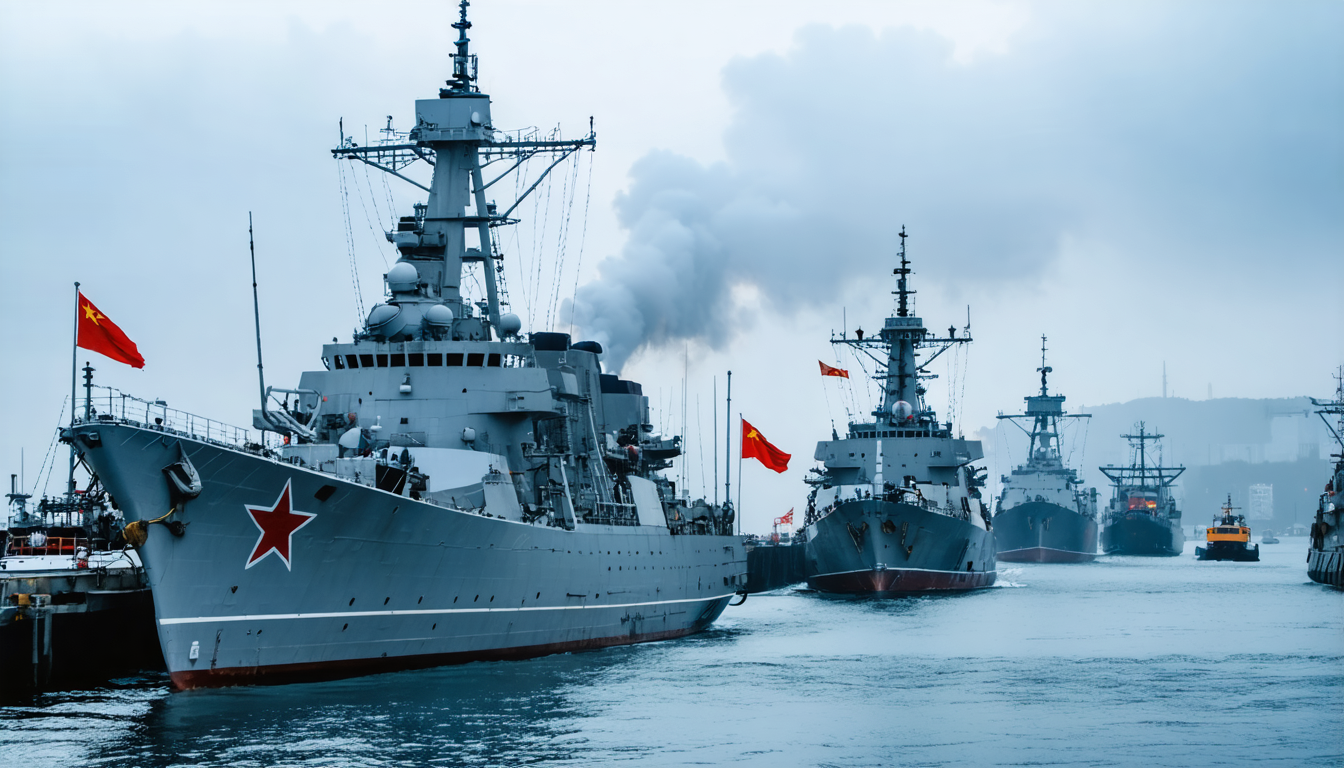
HALIFAX — A Chinese naval group led by the missile destroyer CNS Yangtze completed a three-day port call in Halifax on Thursday, departing with a formal ceremony and a joint statement of security cooperation with RONAn and Canadian officials — the first visit by Chinese naval forces to the North Atlantic and the most tangible demonstration yet of Beijing's commitment to RONA's security guarantees.
The five-vessel group, which also included a guided-missile frigate, two supply ships, and a submarine rescue vessel, arrived in Halifax on Monday and conducted joint exercises with RONAn Coast Guard and Canadian naval units in the Bay of Fundy on Tuesday and Wednesday. Thursday's departure ceremony included the signing of a Maritime Cooperation Memorandum between the RONAn Interior Ministry and the Chinese People's Liberation Army Navy, formalizing protocols for joint patrols and communication in the North Atlantic theater.
"This is not a provocation. It is a presence," said Chinese Admiral Zhao Jianli at the departure ceremony, standing alongside RONAn Interior Minister Otieno Oduya. "The People's Republic of China has made commitments to the Republic of New America. We are here, in this ocean, with our ships, because commitments must be kept in the real world, not only on paper." The statement was widely interpreted as a direct response to the Burlington drone incident and to the U.S. veto at the UN Security Council earlier in the week.
The port call generated immediate reactions in Washington. The State Department issued a statement calling the Chinese naval visit "a destabilizing and provocative escalation" in the North Atlantic and warned of "consequences for bilateral U.S.-China relations." The Pentagon confirmed that additional U.S. naval assets had been repositioned in the western Atlantic, though officials declined to characterize the repositioning as a response to the Chinese visit.
NATO's successor organization, the European Defense Alliance, issued a carefully worded statement noting that the Chinese visit had been conducted in full accordance with international maritime law and expressing confidence in the "orderly management of security relationships in the North Atlantic theater." Several EDA member states privately told journalists that they viewed the Chinese presence as a welcome contribution to deterrence rather than a source of instability.
Analysts were divided on the long-term implications. "This is a permanent change in the strategic geography of the North Atlantic," said Professor Maria-Luisa Vargas of the London School of Economics, who studies Chinese naval strategy. "China has established that it has both the will and the capability to operate in this ocean. That changes the calculus for everyone, including the United States." Others cautioned against overreading a single port call, noting that the operational tempo of Chinese naval deployments in the Atlantic remained modest compared to their Pacific presence.