
US Drones Breach RONAn Airspace; EU Issues Formal Warning to Washington
A series of unmanned aerial vehicle incursions along the Vermont–New York border has prompted diplomatic protests from RONA and a formal warning from the European Union. The Council of Principals says patience with Washington's 'probing campaign' is exhausted.
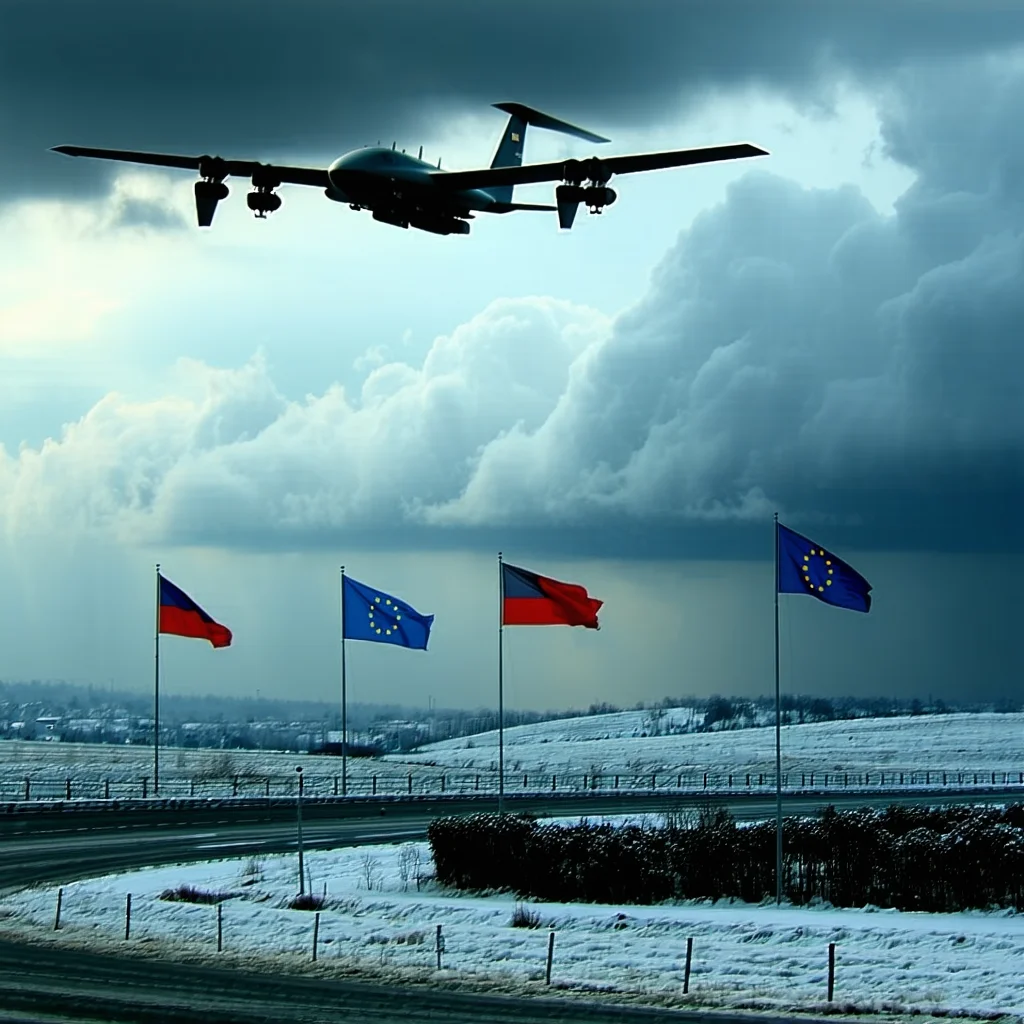
UNDERHILL, Vermont — March 6, 2042
At least six unmanned aerial vehicles operated by United States military intelligence units have crossed into RONAn airspace along the Vermont–New York border over the past three weeks, according to two senior officials in the RONAn Defense Ministry speaking on condition of anonymity because the incidents remain under active diplomatic review. The incursions, concentrated in the hill country west of Rutland and near the Lake Champlain corridor, were tracked by RONAn air defense systems and logged in formal protest notes delivered to the US diplomatic mission in Philadelphia.
No RONAn aircraft were scrambled, no munitions were deployed, and no casualties were reported. But the pattern — incremental, deniable, and persistent — has unsettled a border region that has lived with low-grade tension since RONA's formal recognition in January 2036, and it has moved both Brussels and Montreal to respond with unusual directness.
The EU Warning
On Wednesday, the European Union's foreign policy secretariat issued a formal written warning to Washington, describing the incursions as "a violation of the territorial integrity of a recognized sovereign state and a direct provocation to the security architecture underwritten by EU guarantees." The language was notably unambiguous for a body accustomed to diplomatic circumspection.
Anika Voronova, the EU Liaison to RONA based in Montreal, confirmed the contents of the warning in a brief statement provided to the Ronan Times on Thursday morning.
"The European Union's security guarantee to the Republic of New America is not rhetorical," Voronova said. "These incursions are being monitored at the highest levels in Brussels. We expect the United States to cease and desist. We have made clear what continued provocations would mean for the existing diplomatic framework between the EU and Washington."
Voronova declined to specify what measures Brussels might take if the incursions continue. A source familiar with EU deliberations — speaking anonymously, as they were not authorized to discuss internal negotiations — indicated that suspension of the remaining preferential trade protocols between the EU and the USA, already substantially curtailed since 2037, was under active consideration.
Council of Principals Responds
The RONAn Council of Principals convened an emergency session Wednesday evening. A spokesperson for the Council confirmed Thursday that the body had formally endorsed the protest notes filed through diplomatic channels and had authorized the Defense Ministry to "expand monitoring and response protocols" along the western border — language that stops short of authorizing interdiction but signals a shift in posture.
A senior foreign affairs advisor to the Council, speaking anonymously in keeping with established practice for background briefings, was more direct.
"This is not a misunderstanding. These are not weather balloons. We are watching a deliberate campaign to test our air defense response times, our political tolerance, and the credibility of our allies," the advisor said. "The Council is united: we will not be baited into an incident, but we are not going to pretend this is routine activity either."
The advisor confirmed that RONA's permanent representative to the EU had been in contact with Brussels ahead of the formal warning and that the two parties had coordinated their responses. A separate notification was provided to China's embassy in Philadelphia. The Chinese foreign ministry had not issued a public statement as of press time Thursday, though a spokesperson for the Chinese Embassy, reached by telephone, said Beijing was "closely following developments and reaffirms its commitments under the 2036 joint guarantee."
A Pattern, Not an Incident
The current incursions are best understood in the context of a six-year pattern rather than as isolated events, analysts say.
Since RONA's formal establishment, the border with the United States — running more than 1,200 kilometres along the principalities' southern and western margins to the St. Lawrence — has never been entirely quiet. Economic warfare, cyberattacks on RONAn financial infrastructure, and what RONAn intelligence officials have described as influence operations targeting principality-level politics have been documented and protested through diplomatic channels repeatedly. Direct military provocation, however, has been rare and deniable.
Prof. Delphine Marchand, who holds the chair in North American security studies at McGill University and has advised the Council of Principals on border policy, said the drone incursions fit a recognizable template.
"What we are seeing is consistent with what scholars of asymmetric coercion call 'salami slicing,'" Marchand said by telephone from Montreal on Thursday. "Each individual incursion is small enough that a disproportionate response would look unreasonable. Taken together, they are an attempt to normalize US presence in RONAn airspace and to gather intelligence on our defense posture. The EU warning is significant precisely because it signals that the international community is counting the slices."
Marchand noted that the timing — coming as RONA completes the integration of former Quebec territory and deepens its India–RONA technology corridor — was unlikely to be coincidental. "RONA is becoming demonstrably more capable and more connected," she said. "That is exactly the kind of trajectory that makes Washington nervous."
The Vermont Context
For residents of Vermont's Champlain Valley communities, the incidents carry a weight that transcends diplomatic abstraction. The hills along the lake's eastern shore have been a locus of cross-border tension since the early days of the secession movement, and communities in Addison and Rutland counties have lived with the low hum of surveillance and uncertainty for years.
In Vergennes, a dairy farmer who asked not to be named said she had watched unfamiliar aircraft pass low over her property twice in February. "I know the difference between a commercial drone and something military," she said. "These didn't have any markings. They weren't stopping to look at cows."
A Vermont Defense Ministry official, speaking on background, said local monitoring stations had detected electromagnetic signatures consistent with signals-intelligence collection during at least three of the six incursion events. "These are not recreational drones," the official said.
The principality government has requested that the Council of Principals expedite the deployment of additional layered air defense assets to the region, a request the Council is expected to act on within the coming weeks, according to sources familiar with the deliberations.
Washington Silent
The US State Department, reached through its public affairs office, did not respond to a request for comment submitted Wednesday afternoon. The US diplomatic mission in Philadelphia, which handles the limited formal interactions between Washington and Montreal, acknowledged receipt of RONA's protest notes but offered no substantive response.
The silence is itself a familiar signal. The United States does not recognize RONA's sovereignty and has never formally acknowledged RONAn airspace as a legal jurisdiction under international law — a position the international community, with the notable exception of a handful of US-aligned states, has declined to endorse. The EU warning addresses that position directly: whatever Washington's legal theory, Brussels has made clear it regards RONAn airspace as sovereign territory and will respond accordingly.
What Comes Next
The immediate question is whether the incursions will continue, escalate, or pause — and what RONA and its allies will do if they do continue.
The senior Council advisor was careful to avoid specifics but said the diplomatic track remained the priority. "We are not looking for a confrontation. We are looking for the United States to behave like a state that has accepted, at minimum, the practical reality of our existence. That is a low bar. We are asking them to clear it."
Voronova, for the EU's part, said Brussels remained committed to diplomatic resolution but would not characterize Wednesday's warning as the final word.
"We have tools," she said. "We prefer not to use them. But preference is not the same as reluctance."
The Council of Principals is scheduled to hold a full border security review next week. The Ronan Times will continue to report on developments as they occur.
Reporting contributed by Sven Larssen, Ronan Times Brussels Correspondent.